‘A generational opportunity’: Louisiana climate task force sets eyes on federal dollars

Published: March 10, 2022

By: Claire Sullivan, LSU Manship School News Service

The Louisiana Highway 1 Bridge, rises above marshland and coastal waters on Aug. 25, 2019, in Leeville. (Photo by Drew Angerer/Getty Images)

The Louisiana governor’s Climate Initiatives Task Force met Wednesday for the first time since unanimously passing a climate action plan in January, the first of its kind in the Gulf South.

Fifty public meetings into its 16-month existence, the task force is shifting gears from planning to executing its 84-step action plan. A bipartisan infrastructure act signed into law by President Joe Biden provides a unique opportunity to fund these efforts.

Louisiana is set to qualify for billions of dollars for road repairs, extreme weather preparedness, public transportation, broadband expansion and more. Another $179 billion in competitive federal funds is up for grabs to fund infrastructure projects, with special consideration for climate-focused efforts.

While task force members were optimistic about the prospect of federal funding, they also reckoned with the political uncertainty.

“I really want to encourage folks to pay attention to what’s already being rolled out” in the Louisiana Legislature, Flozell Daniels, president of the Foundation for Louisiana, said, referring to proposals to shield the state’s oil and gas industry from the changes.

“Much of it is designed to undermine the considerable work that’s been put into this plan, and we should acknowledge that,” Daniels said.

Read more at Louisiana Illuminator
Edwards vetoed congressional maps

Published: March 10, 2022

By: Piper Hutchinson, LSU Manship School News Service

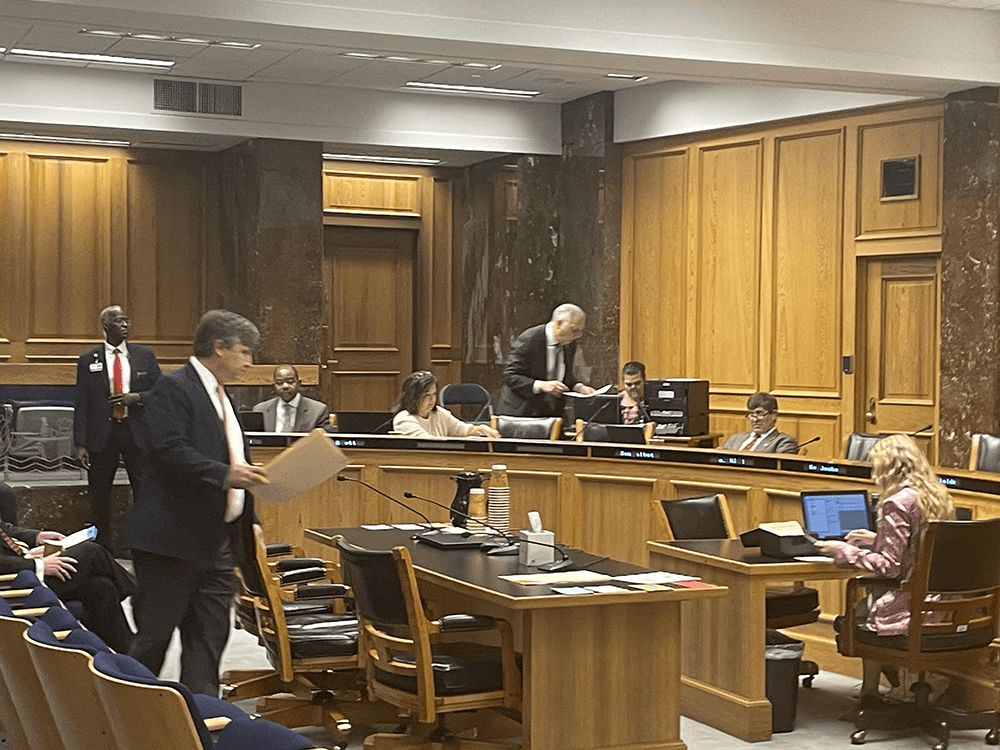
GOV. JOHN Bel Edwards vetoed new congressional maps that did not provide for a second majority-minority district. (Piper Hutchinson/LSU Manship School News Service)

BATON ROUGE–Gov. John Bel Edwards on Wednesday vetoed maps that did little to change the boundaries of Louisiana’s congressional districts, citing the failure to add a second majority Black district. 

“I have vetoed the proposed congressional map drawn by Louisiana’s Legislature because it does not include a second majority African American district, despite Black voters making up almost a third of Louisianans per the latest U.S. Census data,” Edwards said. 

“This map is simply not fair to the people of Louisiana and does not meet the standards set forth in the federal Voting Rights Act,” he added.

Louisiana has six congressional districts, but they are drawn in such a way that a Black candidate could win in only one of them.

Read more at The Franklin Sun

A history of violence: How can a man preach to Black congregations and still be a Klansman?

Published: March 9, 2022

By: Josh Archote, LSU Manship School News Service

— This is the first in a three-part series.

Although 57 years have passed, Leland Boyd still can’t forget the smell of burnt human flesh. 

In December 1964, Leland, then 12, stood in the doorway of a hospital room, where Frank Morris, a 51-year-old Black man from Ferriday, Louisiana, lay in critical condition after two men had torched his shoe shop. 

Morris was a friend of the Boyd family. Leland and his father, Earcel Boyd Sr., spent many afternoons after school in Morris’ shop. He repaired Leland and his siblings’ shoes and even ate dinner at the white family’s home on occasion, and the friendship had continued after Earcel joined the Ku Klux Klan in 1962. 

“Frank, who did this?” Leland, now 70, recalls his father repeatedly asking Morris while he lay in the hospital bed.

“I thought they were my friends,” Morris kept responding.

Morris died from his burns four days later in what the FBI viewed as a racially motivated arson-murder.  Before his death, friends, family members and FBI agents would desperately probe Morris to identify his attackers, but he said he did not know them.

Leland is still haunted by that scene in the hospital room.

“Human flesh smells different when it’s burned than beef, or pork or chicken,” he said. “It’s got an odor that you won’t ever forget. That’s all I could smell. It’s one of those experiences I wish I could get out of my mind.”

Read more at houmatoday

Louisiana Legislature advances political maps that maintain the status quo

Published: Feb. 18, 2022

By: Piper Hutchinson and Alex Tirado, LSU Manship School News Service

On the final day of the redistricting session, the Louisiana House and Senate passed bills Friday that turned back efforts to expand minority representation and preserved the current balance of power in the state’s congressional delegation and the Legislature itself. 

After extensive negotiations, both chambers advanced amended congressional maps, sending two identical bills to Gov. John Bel Edwards’ desk. Black lawmakers immediately called on Edwards to veto at least the congressional map.

HB1, authored by House Speaker Clay Schexnayder, R-Gonzales, and SB5, authored by Sen. Sharon Hewitt, R-Slidell, came out of closed-door negotiations with a compromise: south of Alexandria, the map is faithful to Schexnayder’s proposal, north of Alexandria, the map is faithful to Hewitt’s proposal. 

The Senate passed the amended version of HB1 along party lines with a 27-10 vote. 

Across the hall, the House passed the amended SB5 by a vote of 64-31, with three Republicans joining Democrats to vote against the bill and one Democrat voting in favor of passage. 

Notably, Rep. Travis Johnson, D-Vidalia, voted against the bill. Johnson, a conservative Black Democrat, had been in the hot seat with his party after voting in favor of Schexnayder’s similar congressional bill earlier in the week. 

Rep. Francis Thompson, D-Delhi, was the lone Democrat to vote in favor of the bill. 

Both chambers advanced maps for the Public Service Commission, Board of Elementary and Secondary Education and Louisiana House and Senate with relatively little fuss. None of the bills that passed increased minority representation at any level. 

Read more at Bossier Press-Tribune

‘Too stupid to work together’: Lawmaker rips ‘lazy’ Legislature over Supreme Court bill

Published: Feb. 17, 2022

By: Piper Hutchinson, Lura Stabiler and Alex Tirado, LSU Manship School News Service

BATON ROUGE — The only Republican bill that would have increased minority representation through redistricting died on the House floor Wednesday, prompting its author to give his fellow lawmakers a tongue-lashing.

Rep. Barry Ivey, R-Central, authored HB22, a Supreme Court map that would have created a second majority Black district on the state’s seven-member court. The bill made it out of committee on a bipartisan vote but was involuntarily tabled on the House floor, much to the chagrin of its author.

Rep. Barry Ivey defended his Supreme Court maps before the House and Governmental Affairs Committee on Monday. Alex Tirado/ LSU Manship School News Service.

“We’ll just continue to get by here in Louisiana, because we are too stupid to work together,” Ivey said in a no-holds-barred condemnation.

Rep. Mark Wright, R-Covington, moved to table the bill after asking whether it would be better to consider Supreme Court maps during the regular session in March.

Every House Democrat present voted in opposition to tabling the bill, but the motion passed 53-43, with a handful of Republicans, including Rep. Tanner Magee, R-Houma and the second ranking legislator in the House, and Rep. John Stefanski, R-Crowley, chair of the House committee that oversees redistricting voting, against the motion.

Over the last two weeks, Republicans, who hold roughly two-thirds of the seats in the Legislature, have advanced bills to redraw the maps of the state’s six congressional districts, its 105 House districts and its 39 Senate districts without adding any more majority-minority ones.

They have passed bills that maintain the status quo in the racial breakdowns for members of the Public Service Commission and the Louisiana Board of Elementary and Secondary Education, and they advanced a Supreme Court bill that would leave the current district boundaries largely intact.

Read more at the News Star

Louisiana Senate, House approve bills that maintain status quo

Published: Feb. 15, 2022

By: Allison Kadlubar, Alex Tirado and Lura Stabiler, LSU Manship School News Service

Rep. Barry Ivey, R-Central, proposed a redistricting bill that would create a second majority-minority district for the Louisiana Supreme Court. (Alex Tirado/LSU Manship School News Service)

BATON ROUGE — Two weeks of debate, public testimony and pleas from activists for greater minority representation culminated in a 40-minute Senate floor meeting Monday that advanced two Republican bills mostly maintaining the status quo of the state Senate and Supreme Court district maps.

State representatives then voted 82-21 Monday evening to leave the state House with the same number of minority-majority districts, 29 of 105, that it has now. All of the vote margins in both chambers were large enough to override gubernatorial vetoes if they hold going forward.

“It took a while to get to where we are right now,” Senate President Page Cortez, R- Lafayette, said. “I’m glad that the hawks and the doves kept to themselves today.”

Senate Bill 1, authored by Cortez, kept the state Senate map largely intact with only 11 of the 39 seats representing majority-Black districts.

Sen. Gary Carter, D-New Orleans, pleaded for one final chance to increase minority representation. He said he had spent the weekend meeting with elected and unelected constituents concerning district lines.

“These aren’t just lines on a page,” Carter said. “These are people we represent, who we love, who we fight for, who invite us into their homes.”

Read more at BIZ Magazine

‘Frontline’ revisits Louisiana editor’s work on Ku Klux Klan murder case

Published: Feb. 14, 2022

By: LSU Manship School News Service

LSU Cold Case Project Students Matthew Clark, left, and Alyssa Berry, right, interviewed Henry Austan, who was a member of the Deacons for Defense and Justice. (Courtesy of LSU Cold Case Project)

The work of a longtime Louisiana newspaper editor will be included in a PBS “Frontline” documentary Tuesday on the 1967 Ku Klux Klan murder of Wharlest Jackson, a 37-year-old Black man in Natchez, Mississippi.

Jackson, who had five children, was treasurer of the Natchez NAACP. He was killed when a bomb planted beneath his truck exploded while he was riding home from work.

The editor, Stanley Nelson, researched the Jackson case and other Klan murders for many years before retiring from the Concordia Sentinel in Ferriday in December.

Nelson was a finalist for a Pulitzer Prize in 2011 for his work on a similar case, and he has written two books on cold case murders from the civil rights era. He also helped found the LSU Cold Case Project at the Manship School of Mass Communication, where he works as an adjunct professor.

Entitled “American Reckoning,” the Frontline film also follows the work of Jackson’s wife, Exerlena, a civil rights activist who has since died.

In the film, the couple’s surviving children tell the story of their family and of their quest to find justice for their father.

Read more at Louisiana Illuminator
How Louisiana could be affected by a Supreme Court decision in another state

Published: Feb. 12, 2022

By: Rosel Flores and Piper Hutchinson, LSU Manship School News Service

BATON ROUGE — As it became clear that Republican leaders planned to pass redistricting maps that would not expand minority seats in Congress or the Louisiana Legislature, Black lawmakers said they had two fallbacks — possible vetoes by Gov. John Bel Edwards or lawsuits.

Now both of those options seem a bit shakier.

The Louisiana House and Senate both passed congressional redistricting plans last week by vote margins that would be big enough to override vetoes by Edwards, a Democrat, if the Republicans could muster those votes again.

And last Monday, the U.S. Supreme Court delayed hearing a suit in a similar redistricting fight in Alabama in a move that legal experts say could hint at less court intervention to support minority claims in the future.

In a 5-4 vote, the court’s conservative majority let a redistricting plan passed by the Alabama Legislature stand through this fall’s midterm elections even though an appeals court had ruled that the law may have violated the Voting Rights Act of 1965 in failing to provide for a second minority-majority congressional district.

The Supreme Court, which has trimmed back parts of the voting-rights law in recent years, said it would consider the merits of the Alabama case later. But that is not likely to happen until after the November elections, which will decide the balance of power in Congress.

How would the balance of power be affected?

Republicans and Democrats have been fighting across the country to hold or gain congressional seats through the redistricting process. So if lawsuits challenging the decisions are delayed in many states, that could leave the party with the most power — Republicans in red states like Louisiana and Alabama and Democrats in blue states — in the driver’s seat in those areas.

Peter Robins-Brown, the executive director for Louisiana Progress, an advocacy group, said the Supreme Court decision to let the GOP’s Alabama redistricting map stand for now is likely in Louisiana to “embolden those who were already planning to submit a map that would end up in court and make folks who were planning to challenge those maps feel a little worse.”

Read more at the Daily Advertiser

Manship student featured on lpb for closely following Legislative redistricting Session

LSU Manship school student Piper Hutchinson was featured in a segment on the Louisiana Public Broadcasting show on Feb. 11, 2022. She discussed the current redistricting special session that she has been following closely. Hutchison is a part of the Statehouse Bureau at the Manship School of Mass Communication.

See the whole episode here

High school students spar with legislators redrawing Louisiana House maps

Published: Feb. 11, 2022

By: Margaret DeLaney, Piper Hutchinson and Allison Kadlubar, LSU Manship School News Service

BATON ROUGE — Sparks flew between lawmakers and high school students at a House redistricting committee hearing Wednesday.

A group of teenagers trekked from Shreveport, missing a day of class, to testify in front of the powerful House and Governmental Affairs Committee against a Republican redistricting bill that would not increase Black representation in the Louisiana House.

Kingson Wills, Sabrina Huynh and Ryan Wilkinson took the stand together to speak out against what they called racial gerrymandering. They were met with pushback from Rep. John Stefanski, R-Crowley, the chairman of the committee.

Stefanski pursued a tough line of questioning against the trio, first asking them to identify a district on a proposed House map that had been gerrymandered and to tell him where it was.

Wilkinson identified House District 23 as one such district. Under the proposal put forward by House leaders, the Natchitoches-based majority Black district would be broken up and absorbed by mostly white districts nearby to accommodate plans for a new majority-minority district in New Orleans.

Stefanski pushed back on the claim, as his proposal did not still have House District 23 in northwest Louisiana.

Three high school students (from left) Sabrina Huynh, Kingson Wills, and Ryan Wilkinson — confronted lawmakers at a House hearing on redistricting maps.
Three high school students (from left) Sabrina Huynh, Kingson Wills, and Ryan Wilkinson — confronted lawmakers at a House hearing on redistricting maps. Margaret DeLaney/ LSU Manship School News Service

“Oh yeah, because y’all gerrymandered it,” Wilkinson retorted. 

Read more at Shreveport Times