By: Piper Hutchinson, LSU Manship School News Service
BATON ROUGE — The House Committee on Labor and Industrial Relations on Thursday killed four bills seeking to raise the minimum wage through different approaches.
Louisiana is one of five states that does not have its own minimum wage.
House Bill 472, sponsored by Rep. Tammy Phelps, D-Shreveport, sought to increase the tipped minimum wage. Presently, tipped employees, defined as those who make at least $30 per month in tips, can be paid as little as $2.13 an hour by their employers as long as they make at least $7.25 after tips.
The bill would have increased the employers’ part of the wage to $4.26 an hour.
“None of the good times that we offer here in Louisiana would be possible if it were not for our service employees to work for these businesses,” Phelps said.
By: Olivia C. Landry | LSU Manship School News Service
With the State Capitol standing tall behind them, crews affiliated with Boh Bros Construction work on Fourth Street in downtown Baton Rouge. STAFF PHOTO BY HILARY SCHEINUK
A survey released Thursday suggests Louisiana residents are split almost evenly over whether to maintain legal access to abortions.
The survey, by the LSU Reilly Center for Media & Public Affairs, found that 49% of the 508 residents surveyed opposed legal access to abortions in all or most cases, and 46% supported it. The difference is within the poll’s margin of error.
In a similar survey in 2016, 55% of state residents thought abortion should be illegal in all or most cases while 40% thought it should be legal.
The shift occurred primarily among Democrats. Over the last six years, the level of Democratic support for legal abortions rose to 74% percent from 51%, and the percentage of Democrats opposed to legal abortion fell to 19% from 42%.
BATON ROUGE — In the fifth installment of the 2022 Louisiana Survey, released Tuesday, residents say the most common barrier to having broadband internet is the cost of the service.
The survey, sponsored by the Reilly Center for Media & Public Affairs at LSU’s Manship School of Mass Communication, was based on online and phone responses from 508 Louisiana residents.
The survey found that 75% of respondents already had broadband internet service in their homes.
Another 6% said they subscribe to internet service, but it is a slower dial-up service.
About 20% of respondents stated that they do not have broadband or dial-up in their homes.
Providing greater access to high-speed internet services in rural and lower-income urban areas has been a priority of federal and state officials to support education and economic development, and the survey’s findings help delineate the extent of the problem.
By: Piper Hutchinson, LSU Manship School News Service
BATON ROUGE — The Senate Committee on Education unanimously advanced a bill Thursday that would stop the reporting of household income for TOPS recipients.
Senate Bill 81, sponsored by Sen. Bodi White, a Central Republican, would eliminate the requirement for TOPS recipients to report their family’s income.
Students who benefit from the Taylor Opportunity Program for Students, a merit-based scholarship that covers tuition costs for in-state students, are required to provide significant demographic information.
White’s original bill also would have nixed the requirement for reporting on race and gender. But it was amended to only do away with income reporting.
About 58,000 students took advantage of the scholarship in the 2020-2021 academic year. Of the 15,000 high school graduates who were awarded tops at the end of the 2020 school year, about 40% of them came from households with annual incomes of at least $100,000.
The median household income in Louisiana is $49,000.
Rep. Jerome “Zee” Zeringue, R-Houma presents budget bills Thursday in the Louisiana House of Representatives. (Piper Hutchinson/LSU Manship School News Service)
The Louisiana House of Representatives passed a package of budget bills on Thursday, including a proposed $38.6 billion state operating budget with pay raises for K-12 teachers and college faculty.
A separate spending bill for infrastructure projects did not include the full $500 million Gov. John Bel Edwards has sought to lay the groundwork for a new Mississippi River bridge at Baton Rouge.
Republican leaders raised concerns about spending that $500 million immediately, especially when a location for the bridge has not yet been finalized.
Instead, they proposed moving that money into a fund and opened it up to a number of other projects.
BATON ROUGE, La. (LSU Manship School News Service) — While a majority of Louisiana residents are confident in the elections in the state, trust in local news organizations has plummeted.
The fourth installment of the 2022 Louisiana Survey, released Thursday, reports general confidence in election security but a declining trust in local news organizations.
The survey, released in a series of six reports sponsored by the Reilly Center for Media & Public Affairs at LSU’s Manship School of Mass Communication, was based on online and phone responses from 508 Louisiana residents.
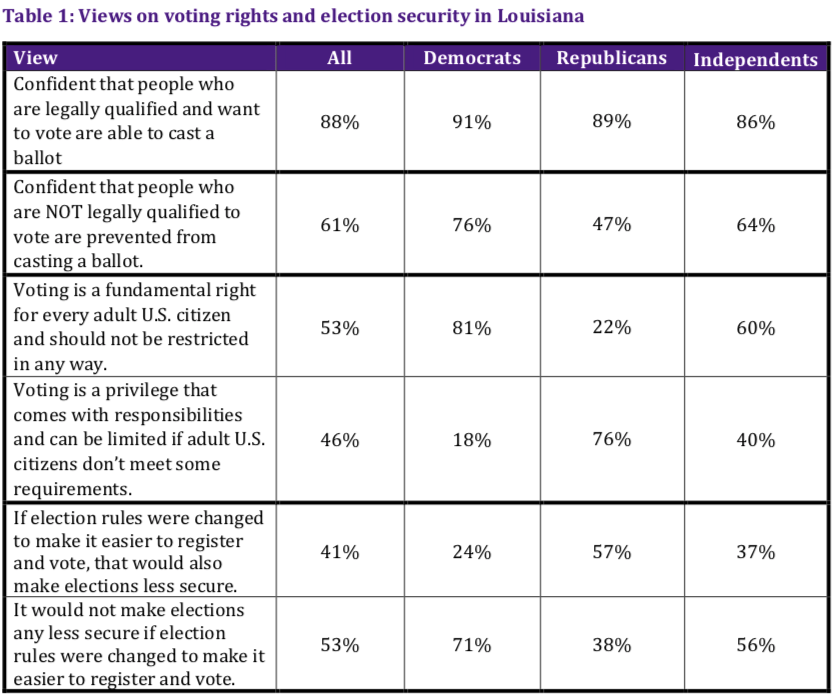
Table showing views on voting rights and election security among political parties in Louisiana. (2022 Louisiana Survey)
The survey found that 88% of respondents were very or somewhat confident that legally qualified individuals who wish to vote are able to in Louisiana.
State Senator Gerald Boudreaux addresses the crowd attending the groundbreaking ceremony for the relocation of Basin Arts in the historic church at 710 Jefferson Blvd, in Lafayette on Thursday, March 3, 2022. PHOTO BY ROBIN MAY
The state Senate advanced a bill 36-0 Wednesday that would provide financial support for new and existing post-secondary education programs for students with intellectual and developmental disabilities.
Louisiana currently offers six higher education programs that allow students with these types of disabilities to enjoy a college experience and grow educationally and socially.
If approved by the House, the fund would help the students increase their social and communication skills, develop employment skills and produce self-sufficient young adults who could become successful employees.
Senate Bill 192 was sponsored by Sen. Gerald Boudreaux, D-Lafayette, and was discussed more thoroughly on Monday in the Senate Finance Committee, where a large crowd attended to show support.
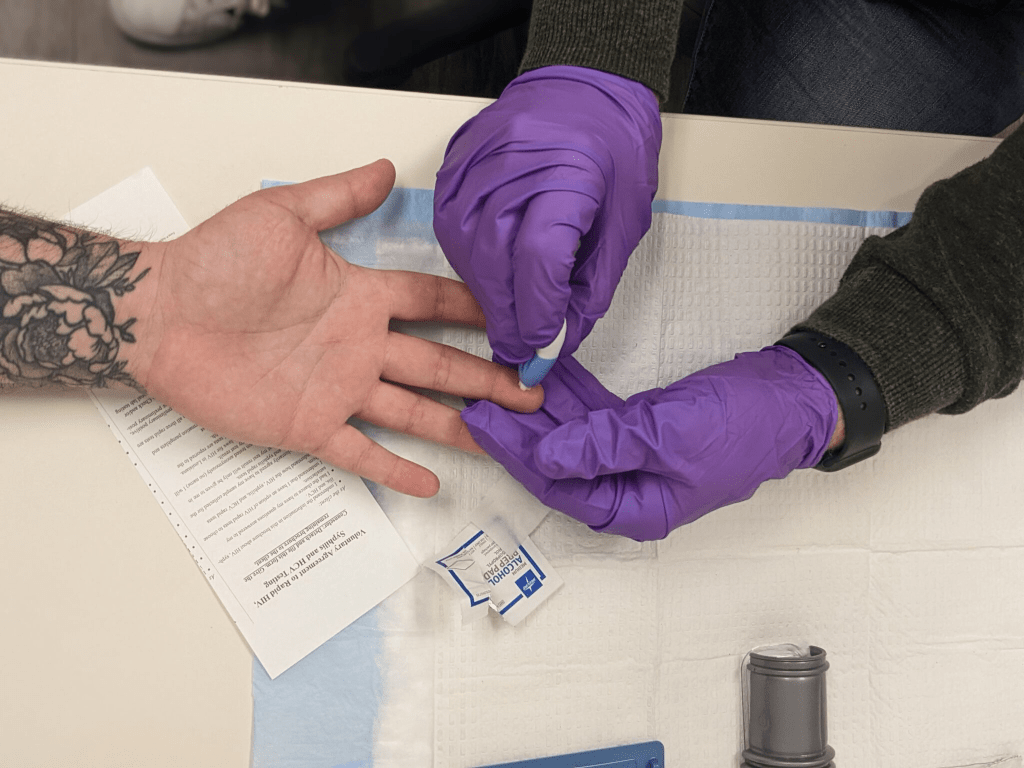
The number of HIV tests like this one at Crescent Care in New Orleans dropped sharply during the COVID-19 pandemic (Photo courtesy of Crescent Care)
For decades, Louisiana was one of the worst states for HIV transmission, and in 2015, healthcare leaders created a plan to try to end the epidemic.
As they expanded access to prevention tools and health services and pushed to ease the stigma surrounding the human immunodeficiency virus, new diagnoses dropped by more than 20%, and by 2019, Louisiana no longer ranked among the 10 states with the highest transmission rates.
Then COVID hit, forcing immunocompromised people like HIV sufferers to isolate themselves. Many of the more than 22,000 Louisiana residents with HIV or AIDS lost in-person access to health providers, and newly diagnosed patients did not get the treatments that can keep them from transmitting the virus. Testing sites also administered far fewer tests, and five years of progress evaporated.
Preliminary data suggests that after a multi-year decline, new HIV diagnoses increased by about 33%, from 722 in 2020 to 960 in 2021, according to the Louisiana Department of Health.
“We don’t know exactly why that was the case,” said Sam Burgess, the STD/HIV program director at the health department. “We certainly know there was a lot less testing in 2020 and 2021. There were a lot of calls out to the public to avoid routine medical visits, so I think a lot of people delayed their screenings for sexual health. Some of the folks who probably would have been diagnosed in 2020 were diagnosed in 2021.”
Testing is picking up again with the recent lull in COVID cases, but the totals are not reaching pre-pandemic numbers.
Testing efforts at Crescent Care, one of the main HIV/AIDS treatment centers in New Orleans, were cut in half over the last two years. The clinic administered almost 8,000 HIV tests in 2019. Because lockdowns limited many patients to telehealth visits, the number decreased to 4,000 in both 2020 and 2021.
“The most effective means of HIV testing is getting out in the community and testing people,” said Dr. Jason Halperin, an infectious disease specialist at Crescent Care. “In lockdowns and social distancing, all of that testing has stopped.”
By: Allison Kadlubar, LSU Manship School News Service
BATON ROUGE — Louisiana residents are concerned about damage from hurricanes and fear the unsettling reality of the state’s eroding coastline.
According to an LSU survey released Tuesday, 40% of respondents who have insurance said they filed property damage claims since 2020.
Hurricanes Ida, Laura, Delta and Zeta left Louisiana residents with billions of dollars in damages, especially people in South Louisiana and metro New Orleans.
The respondents who had filed insurance claims were evenly divided in assessing how the companies handled their claims, with 47% satisfied and 47% dissatisfied.
But more than half of the respondents with homeowner’s insurance said their premiums have increased.
By: Lura Stabiler, LSU Manship School News Service
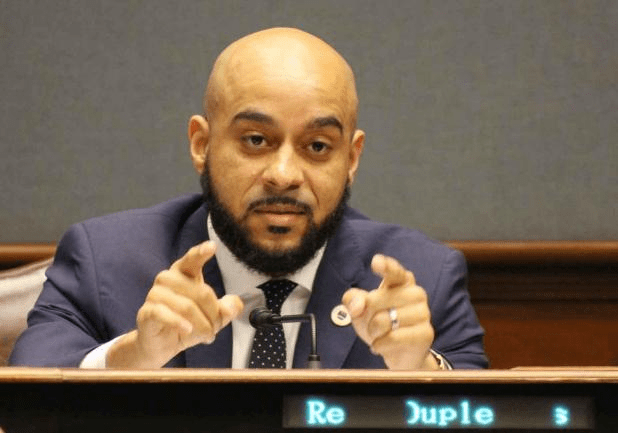
Rep. Royce Duplessis, D-New Orleans, sponsored a bill to provide for perinatal mood disorder screening, specifically for postpartum depression. /LSU Manship School News Service/Sarah Gamard
BATON ROUGE—On Black Maternal Health Advocacy Day Wednesday, the House voted 101-0 to pass a bill to provide for perinatal mood disorder screening, specifically for postpartum depression and awareness.
Rep. Royce Duplessis, D-New Orleans, authored the mental health bill, House Bill 784, to help deal with Louisiana’s alarming maternal and infant mortality rates. Louisiana has the highest maternal death rate in the country and the second-highest infant death rate.
At a House Health and Welfare Committee meeting earlier this month, Robin Gruenfeld with the March of Dimes said, “One in seven women experience symptoms of depression during their pregnancy and the 12 months following delivery. These women are more likely to give birth preterm or experience the loss of an infant.”
The bill requires healthcare providers who offer postnatal care to screen patients for signs of postpartum depression or related health disorders. The healthcare provider will likely be the new mother’s obstetrician or their child’s pediatrician.



 LSU Manship School Statehouse Bureau