Several bills being supported to regulate abortions in Louisiana

Abortion+Supportesrs
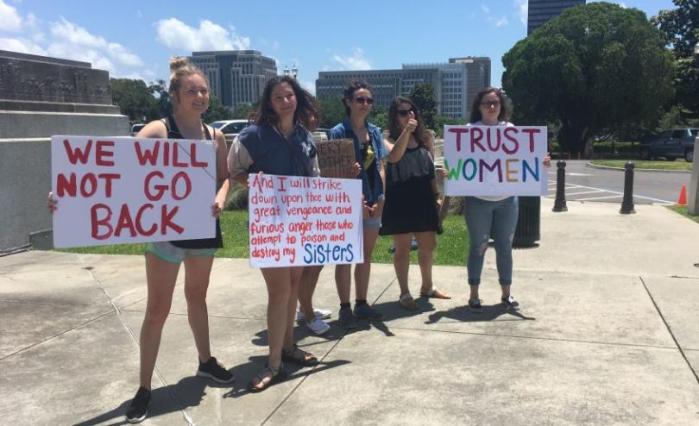
Pro-choice protesters rallied outside of the State Capitol in Baton Rouge on Tuesday as legislators advanced several abortion bills. (Photo credit: Hunter Lovell, LSU Manship School News Service)

By: Lauren Heffker & Hunter Lovell, LSU Manship School News Service

Published: May 21, 2019

BATON ROUGE–Abortion continues to top the legislative agenda this week as Louisiana lawmakers in the House Health and Welfare Committee supported several bills on Tuesday that would further regulate abortions in the state.

Two key proposals would require abortion providers to give their patients detailed background information before performing an abortion and permit abortion facilities to report suspected human trafficking crimes to law enforcement.

Both bills were sponsored by Sen. Beth Mizell, R-Franklinton, and now move to the House floor for final passage.

One of the bills would change the existing Women’s Right to Know law, which means that women must give informed consent prior to having an abortion.

Mizell’s proposed legislation would expand the existing law. Abortion providers would have to supply written information about their background, including qualifications, past conduct and the location of the physician’s residency.

In Louisiana, patients can research their doctor’s qualifications, but information about the identities of physicians who perform abortions is not disclosed online.

Read more in KALB.
Senate panels advance bills to curb domestic violence

5ce53a7ae1061.image
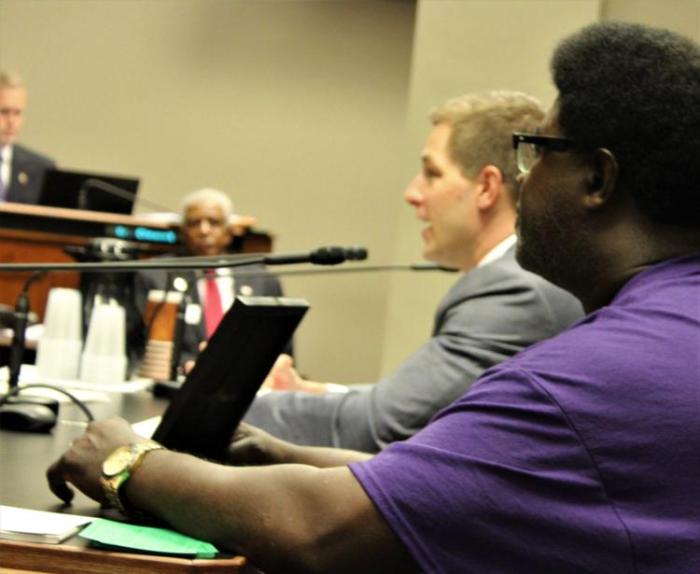
In an effort to tighten laws protecting domestic abuse victims, Rep. John Stefanski, R-Crowley, left, discusses legislation named after Tracy Andrus’, right, daughter who was murdered by her husband. (Photo credit: Madeline Meyer, LSU Manship School News Service)

By: Madeline Meyer, LSU Manship School News Service

Published: May 21, 2019

BATON ROUGE–Louisiana legislators advanced bills in Senate judiciary committees Tuesday that would curb domestic violence, take steps to prevent sexual abuse of youth athletes, and study incentives to reduce the state’s high divorce rate.

Lawmakers from both sides of the aisle have taken strides to address and prevent domestic violence.

Gov. John Bel Edwards, a Democrat seeking re-election in the fall, has expressed his concerns about the high number of domestic violence incidents in the state.

“It is shocking but true, Louisiana ranks third nationally when it comes to domestic violence, and we should all be moved to bring an end to this senseless act,” the governor said at an event last October in which he raised awareness for survivors and their families.

Members of the Senate Judiciary C Committee advanced House Bill 36 by Rep. John Stefanski, R-Crowley, which would require local law enforcement officers to receive and review a copy of protective orders. The bill would also require law enforcement agency to inform victims that filing a protective order does not automatically press criminal charges against their perpetrator.

Protective orders, commonly referred to as restraining orders, prohibit a person from being near another person with the intention to prevent abuse.

HB36, referred to as “Heather’s Law,” is named in honor of Heather Mouton, who was shot and killed by her husband last May in Crowley while their three children were present. Although Mouton had filed a restraining order, the courts had not yet taken up the case to enforce the order.

Read more in The Advocate.

Committee advances bill to phase out half-cent sales tax by 2023

Screen Shot 2019-05-24 at 2.48.01 PM
Rep. Lance Harris, R-Alexandria, presents his proposal before the House Appropriations Committee on Monday to phase out the extra 0.45 of a cent of the state sales tax that the Legislature extended last year. (Photo credit: Tryfon Boukouvidis, LSU Manship School News Service)

By: Tryfon Boukouvidis, LSU Manship School News Service

Published: May 20, 2019

BATON ROUGE — The House Appropriations Committee on Monday advanced a proposal on a 12-5 vote along partisan lines that would phase out the portion of the state sales tax that the Legislature extended last year after nearly five months of partisan dispute.

The bill, sponsored by Rep. Lance Harris, R-Alexandria, would reduce the extra 0.45 of a cent of sales tax by one-tenth of a penny every year from 2020 to 2022 and repeal the rest in 2023.

Under this proposal, the state is projected to lose $392 million in revenues by 2024.

“This particular piece of legislation speaks to giving individuals and taxpayers some of the money back that we extract out of their pocket on a temporary basis,” Harris said.

Matthew Block, who represents the governor, expressed that Gov. John Bel Edwards–a Democrat seeking re-election this fall–does not support this proposal.

“This bill eliminates and tries to roll back a hard-fought but well-supported compromise in which not everybody got what they wanted,” Block asserted. Keeping the compromise in place, Block added, would put the state “on a sound fiscal footing for the first time in a long time.”

Read more in The Advertiser.

House panel advances Senate-passed bill to require drug testing after serious traffic accidents

Screen Shot 2019-05-24 at 2.34.47 PM
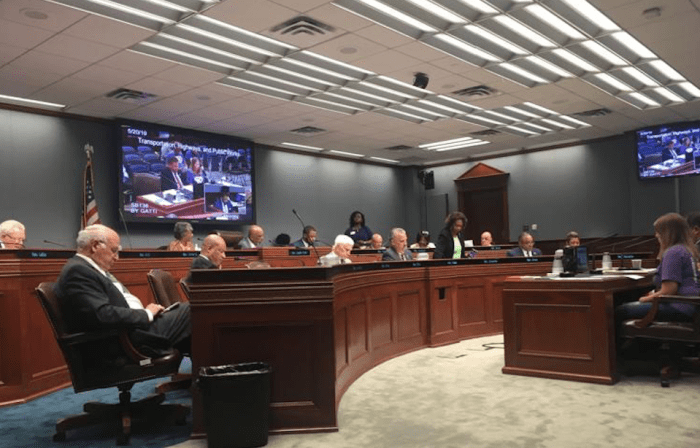
Lawmakers discuss several bills on drug testing after serious traffic accidents and fine exemptions for uninsured drivers during the House Transportation Committee on Monday, May 20, 2019. (Photo credit: Hunter Lovell, LSU Manship School News Service)

By: Lauren Heffker & Tryfon Boukouvidis, LSU Manship School News Service

Published: May 16, 2019

BATON ROUGE–The Louisiana House Transportation Committee advanced two bills on Monday that would permit drug testing in severe traffic accidents and waive penalties for uninsured drivers under special circumstances.

Sen. Ryan Gatti, R-Bossier City, sponsored Senate Bill 138 that would mandate either chemical, blood or urine testing in a traffic crash involving serious bodily injury or death. Gatti’s bill defines serious bodily injury as one that is “severe” or “incapacitating.”

Louisiana’s current law allows for post-accident drug testing only when a collision results in an on-site fatality. The proposed bill, however, would expand the existing law.

If the bill were to become law, it would be known as “Katie Bug’s Law,” named after 4-year-old Katie Grantham of Bossier Parish, who was killed in an auto accident in 2017. Though Katie’s mother, Morgan Grantham, suspected the driver who hit them was impaired by drugs, he was not tested by police since Katie did not die at the scene.

Katie suffered critical injuries to her spinal cord and was taken off life support after seven days in the hospital. The driver, who ran a red light north of Bossier City, served 10 days in prison. Without more sufficient evidence, such as a drug test, prosecutors could only charge him with a traffic violation, instead of negligent or vehicular homicide.

Read more in The Advocate.

House committee rejects bills for minimum wage changes, equal pay for women

ffff
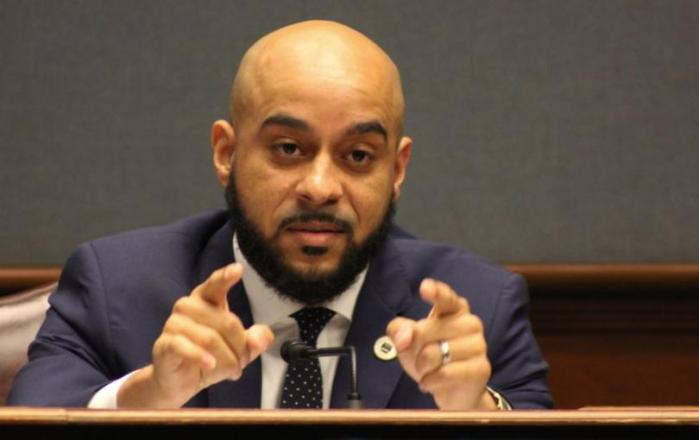
Rep. Roy Duplessis, D-New Orleans, questions critics of a bill that would allow local authorities determine minimum wages. (Photo credit: Madeline Meyer, LSU Manship School News Service)

By: Madeline Meyer & Lauren Heffker, LSU Manship School News Service

Published: May 16, 2019

BATON ROUGE–The House Labor Committee rejected bills on Thursday to let local authorities determine their own minimum wage rates and to implement equal pay measures for all women in Louisiana.

The panel voted 9-6 against the minimum wage bill.

Rep. Royce Duplessis, D-New Orleans, who sponsored the bill, said the state should not keep cities “in a chokehold and prevent them from being able to do what they think is in their best interest.”

The committee voted 9-6 to reject the bill to require equal pay for all women, including part-time workers.

In 1997, Louisiana was one of the first states to adopt the federal minimum wage. At that time, the state passed a law that revoked local governments’ authority to set minimum wages. Duplessis’ bill would have repealed that decision.

Gov. John Bel Edwards, a Democrat who is up for re-election, has advocated raising the minimum wage across the state for the past three years. In April, the governor also endorsed a constitutional amendment that would ask voters to decide on a $9 minimum hourly rate.

Sixteen people spoke in favor of Duplessis’ bill. Almost 100 people attended the hearing to support the bill.

Read more in KALB.

PTSD would be added to the list of injuries eligible for public employee benefits under bill

5cdde9150327a.image
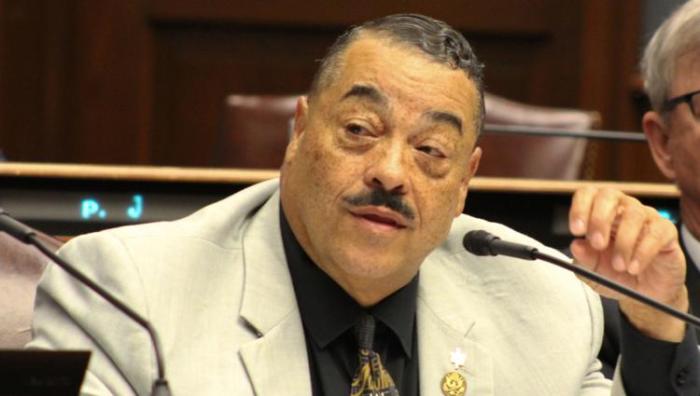
Rep. Kenny Cox, D-Natchitoches, commented on the bill. (Photo credit: Madeline Meyer, LSU Manship School News Service)

By: Lauren Heffker, LSU Manship School News Service

Published: May 16, 2019

BATON ROUGE–In a move to address mental illness among firefighters and police officers, a House committee advanced a bill Thursday that would add post-traumatic stress disorder, or PTSD, to the list of injuries eligible for public employee benefits.

The Senate had already approved the bill, and it now moves to the House floor.

“In the old days, we said ‘suck it up, buttercup,’ and ‘man up,’ and that became not really a good coping skill to teach people,” said Sen. Ryan Gatti, R-Bossier, who sponsored the bill.

Members of the House Labor Committee discussed the bill in an emotional hearing during which several public servants and employees spoke about their mental health problems.

“Our numbers are rising,” said Matt Kinney, who works for the Bossier City Fire Department. “Our firefighters and police officers are dying. They don’t have the support or the means that they need.”

Kinney pointed out the detrimental effects of not treating PTSD, including substance abuse and high divorce rates among firefighters.

Read more in The Advocate.


‘Fetal heartbeat’ bill clears Louisiana House, Senate committees

I2PEWBLW4JAANLNZEN6JDYIK2Q
Abortion rights advocates poured fake blood on the floors of Memorial Hall at the Louisiana state capitol Wednesday in protest of the “fetal heartbeat” bill that advanced out of House and Senate committees. The protests led to several arrests. (Photo credit: Hunter Lovell, LSU Manship School News Service)

By: Lauren Heffker & Tryfon Boukouvidis, LSU Manship School News Service

Published: May 15, 2019

BATON ROUGE — Legislation that would limit or ban abortion in Louisiana easily cleared House and Senate committees on Wednesday, echoing a surge of similar bills in Republican-controlled legislatures in the South.

Pro-choice advocates protested the bills inside the state Capitol. The protests led to several arrests after demonstrators poured fake blood onto the marble floors in Memorial Hall.

The House Health and Welfare Committee advanced a controversial proposal that would outlaw the abortion of a fetus with a detectable heartbeat, which usually occurs around six weeks.

The “fetal heartbeat” bill, sponsored by Sen. John Milkovich, D-Shreveport, has received bipartisan support and was approved last week by the Senate. Gov. John Bel Edwards, a pro-life Democrat running for re-election, has publicly supported it.

In March, Edwards said he would be inclined to sign the bill into law.

“States across the nation are saying, ‘We are no longer going to devalue life,” Milkovich said. “We are going to acknowledge the sanctity of human life.’”

Read more in The Advertiser.

Special education classrooms could soon be monitored by camera at parents request

Classroom+Cameras+Bill00000000
Mark Wright, R-Covington (on left), discussed a bill that would require schools to install cameras in special education classrooms upon a parent’s request. (Photo credit: Sheridan Wall, LSU Manship School News Service)

By: Sheridan Wall, LSU Manship School News Service

Published: May 14, 2019

BATON ROUGE–Special education classrooms in Louisiana public schools might be monitored by cameras under a bill advanced by the House Education Committee on Tuesday.

The bill, by Rep. Mark Wright, R-Covington, would allow parents of children in self-contained special education classrooms to request that a camera be installed to monitor class activity.

“Under no circumstance was this bill meant to be a criticism of schools or teachers or any kind of gotcha moment,” Wright said. He added that his proposal is meant to be a “dispute resolution tool first and foremost.”

If installed, a camera would remain throughout the duration of the school year. Parents could submit a request the next year if they wanted their child’s classroom to continue to be monitored. Schools would be required to store camera footage for a month.

Wright said the idea resulted from a recent lawsuit in his district involving poor classroom treatment of special needs children. The bill might need to be considered by other committees and also would require passage by the full House and Senate.

Kathleen Cannino from St. Tammany Parish, the mother of a child with a genetic disorder, said she supports more accountability. She added that the cameras could “save a lot of heartache for a lot of parents and children.”

Read more in KALB.

State House bill advanced to allow patients to inhale medical marijuana

MARIJUANA+MAN00000000
(Sarah Gamard, LSU Manship School News Service)

By: Hunter Lovell, LSU Manship School News Service

Published: May 14, 2019

BATON ROUGE–The House advanced a bill Tuesday that would allow patients to inhale medical marijuana.

The bill, sponsored by Rep. Ted James, D-Baton Rouge, passed in a 73-3 vote and now goes to the Senate.

James said the bill would not permit smoking. The medical cannabis would be breathed through a device similar to an asthma inhaler.

The sale of the raw plant form of marijuana is still prohibited in Louisiana.

James also included an amendment that would allow doctors who live outside the state to recommend therapeutic medical marijuana usage. Current law only authorizes licensed in-state physicians to approve marijuana treatments.

Patients must have “debilitating medical conditions” to legally use medical cannabis in the state. Those conditions include cancer, epilepsy, Parkinson’s disease, intractable pain, and human immunodeficiency virus, or HIV.

It is still not clear when medical marijuana will be administered to patients in the state. Both chambers passed legislation in 2015 to allow the drug to be used by patients with debilitating conditions.

Read more in KALB.

Senate advances bill to establish legal marriage age in Louisiana

3DOQW7HAOBFBNFSXQ3JRLTDJ6U.JPG
(Photo credit: Fox8)

By: Lauren Heffker, LSU Manship School News Service

Published: May 15, 2019

BATON ROUGE–A Louisiana Senate committee moved to advance a bill Tuesday (May 14) that would make 18 years old the youngest possible age for a person to get married in the state

The bill, sponsored by Sen. Yvonne Colomb, D-Baton Rouge, will now move to the Senate floor, where it is expected to be amended.

There is currently no legal minimum for marriage in Louisiana. Presently, 16 and 17-year-olds must have parental consent to be wed, and anyone under the age of 16 must also obtain permission from a juvenile court judge.

In neighboring states like Texas, the minimum age is 16 and requires a judge’s consent. In Mississippi, parental consent is required for men aged 17 and women aged 15 and above. In Arkansas, the minimum age for minors to marry is 17, with parental consent.

Senator Rick Ward III, R-Port Allen, said although made with good intent, the bill will not guarantee a solution.

“A lot of times we make an attempt to take corrective action to something, but as we all know, just because we put something in law that doesn’t necessarily mean that the bad actors follow that law,” Ward said.

Read more in Fox8 News.