Louisiana residents on both sides of the aisle think they are paying too much in sales taxes

(AP)

Published: April 6, 2021

By: Samantha Beekman | LSU Manship School News Service

BATON ROUGE, La. (LSU Manship School News Wire) – In 2018, it was only one-sixth of a penny that divided legislators over how much of an expiring penny of sales tax to extend before they compromised on 0.45%.

Now, Louisiana residents on both sides of the aisle think they are paying too much in sales taxes, as indicated by new data from the LSU Public Policy Research Lab.

(Source: LSU Manship School News Wire)

According to a survey that the lab released Tuesday, 61% of Republicans and 53% of Democrats think that the state sales tax is too high – a bipartisan majority of Louisiana residents.

Since July 2018, the state sales tax rate has been 4.45%, a decrease from 5% the state had levied for the two years before that. That 0.45% portion was extended until 2025, and parishes add their own sales taxes to purchases.

Combining state and local sales tax rates, Louisiana has the second-highest average sales tax rate in the nation at an average of 9.55%, according to data from the Tax Foundation.

Despite widespread grievances with sales taxes, 52% of Louisiana residents say they pay about the right amount in overall state taxes. Half of the survey respondents think that upper-income people pay less than their fair share of state taxes, and a majority – 56% – say the same about large businesses.

Read more at KALB

Louisiana GOP loses almost 8,000 registered voters after riot at US Capitol

Published: Sarah Procopio | LSU Manship School News Service

April 5, 2021

BATON ROUGE — Party registration data from the secretary of state’s office reveals that roughly 7,800 Louisiana voters have left the Republican Party since the attack on the Capitol on Jan. 6.

Dips in registrants for the party have been seen around the country. A report fromThe New York Times found more than 100,000 Republicans left the party in a number of states in the weeks after the U.S. Capitol riots, and Louisiana’s voter registration numbers mirror that trend.

Tanner Magee, the second-ranking Republican in the Louisiana House as its speaker pro tempore, cited the challenges national politics creates for public officials at home.

“I’m not sure there’s anything that I can do on a state level other than try to be the best legislator I can and do the best for the state of Louisiana, and hopefully, if you have some people out there that are more state-focused in their thoughts, that might mean something to them,” said Magee.

Tanner Magee, the No. 2 Republican in the Louisiana House, said party registration totals can be affected by national politics.
Tanner Magee, the No. 2 Republican in the Louisiana House, said party registration totals can be affected by national politics. Courtesy of Tanner Magee

The Republican Party lost 5,503 registrants in January, 1,709 in February and 598 in March. The three months of losses came after more than 12 months of steady increases in Republican registrations

Democrats lost over 8,000 voter registrations in Louisiana between January and April. But unlike the Republican Party, Democrats saw losses in most months in 2020 and 2021.

The recent drop in Republican registrations also stood out because the party has had an increase of roughly 37% increase in registrants in Louisiana over the last 10 years while Democratic registrations have dropped by about 12%.

The size of the decrease of 7,810 Republican Party registrations so far this year has not been seen in the months after other recent presidential election cycles. From January through March in 2017, the Republican Party in Louisiana gained 2,206 registrants. In 2013, there was a 1,171 decrease of Republican registrants during the same months.

Read more at Daily Advertiser

Louisiana is ranked 45th in the nation in COVID-19 vaccinations. Here’s why.

Published: April 6, 2021

By: Samantha Beekman | LSU Manship School News Service

BATON ROUGE — In the four months since the first vaccination against COVID-19 in Louisiana, over 2 million doses of the vaccines have been administered across the state, the Louisiana Department of Health reported Monday.

Over one in four Louisianans have received at least one dose of the vaccine, and about 17.9% are considered fully vaccinated. 

Praise for the vaccine accompanies vaccine selfies and pictures of vaccination cards on social media, and many are encouraging others to get the vaccine as well.

“Everyone should go out and get this done!” Thomas G. Voss, Ph.D., posted on Twitter in the week leading up to this milestone. “The life you save could be your own.”

Friday, LSU football fan Zach Rau posted: “If you’re on the fence about vaccination, consider what joys await you in the fall at the tailgate.”

Why is the state behind on vaccinations?

Despite these gains, Louisiana ranks 45th in the nation in the percentage of its population that has received at least one dose of the vaccine, according to data from the Centers for Disease Control and Prevention released Sunday. New data from the LSU Public Policy Research Lab could help explain why the state is behind. 

According to a survey that the lab released Thursday, a third of Louisiana adults said that they would refuse a vaccine against COVID-19. This figure includes 43% of Republicans who do not intend to receive the vaccine even when they are eligible. They are joined by only 13% of Democrats who do not want the vaccine.

A third of Louisiana adults said that they would refuse a vaccine against COVID-19, according to new data from the LSU Public Policy Research Lab
A third of Louisiana Adults said they would refuse a vaccine against Covid-19, according to new data from the LSU Public Policy Research Lab. Photo Provided by LSU Manship News Service

This reticence comes even as health care experts herald the vaccine as the key to ending the pandemic and reopen the economy. In a press conference Tuesday, Gov. Edwards said one of the best strategies to “win the race” is vaccination in conjunction with masking and social distancing.

While state and national officials have been concerned with racial inequity in vaccine administration among people in minority communities, survey data suggests that mistrust of the vaccine does not fully explain the slow start in equitable vaccination.

Read more at News Star

Applications open in 47 parishes for companies wanting to provide fantasy sports betting

Published: Feb, 23, 2021

By: Ryan Nelsen | LSU Manship School News Service

Mike Noel, chairman of the Louisiana Gaming Control Board, says fantasy sports betting sites could be operational by late spring. (Photo courtesy of the Louisiana Gaming Control Board)

BATON ROUGE–More than two years after voters in most parishes approved fantasy sports contests, businesses can finally begin applying for licenses to begin operating the games within the state.

The Louisiana Gaming Control Board has published its final regulations for the prize contests, and the State Police’s gaming commission opened the application process Friday.

The approval process will take 60 to 90 days for each company, according to Maj. Chuck McNeal of the Louisiana State Police Gaming Enforcement Division. The applications must be submitted by mail, and as of Monday afternoon the department has yet to receive any applications.

Part of the process for the businesses will be to create virtual barriers around the 17 parishes that did not vote in favor of allowing fantasy gambling.

“They’re going to be, for lack of a better word, geofencing along parish lines, whether it be the parishes who opted out are blocked out, or the parishes that opted in are blocked in,” said McNeal.

Many states, like New Jersey, use this technological barrier to prohibit entrance into contests from across state lines, but the applicants will have to prove their software works along state and parish lines in Louisiana.

“They’re going to have to demonstrate that to us, and then they’re going to have to go to one of the state-approved regulatory gaming labs and prove to them also that it is not allowed to be played in the parishes that opted out,” said McNeal.

Read more at BRProud.com

Criminal justice advocates to push for increased funding for public defenders in upcoming legislative session

Published: April 1, 2021

By: Mahogani Counts | LSU Manship School News Service

Norris Henderson, the founder of a non-profit called Voice of The Experienced, is among the advocates pushing for changes in the criminal justice system. (Photo courtesy of Henderson)

BATON ROUGE–In this spring’s legislative session, criminal justice advocates will be pushing for increased funding for public defenders and for changes in policing practices.

Norris Henderson, the founder of Voice of The Experienced, a non-profit known as VOTE, said both areas represent crucial steps in reforming the state’s justice system and making it fairer for minorities.

The Legislature provided an extra $3 million for public defenders last year and is looking at whether to provide more. Police tactics came under question around the country after the death of George Floyd in custody last year in Minneapolis, and Louisiana lawmakers created the Police Training, Screening and De-escalation Task Force to address those practices here.

As of now, with the trial of one of the officers in the Floyd case in the headlines, the task force has made 21 recommendations for legislators to consider once the session begins.

These recommendations include bans on chokeholds, a prohibition of “no-knock” warrants, requirements for officers to wear and turn on body cameras, reducing time for officers to find legal representation and reducing the time to complete an investigation of officers involved in possible wrongdoing.

VOTE was formed in 2004, and it aims to uphold civil rights for individuals who are most impacted by the justice system.

Henderson was drawn to social justice work because he was directly impacted by the system. In 1997, he was wrongly convicted of murder and served 30 years in prison until the Supreme Court overturned his case in 2004.

Norris Henderson began looking into criminal justice issues while he was wrongly incarcerated (Photo courtesy of Henderson)

Read more at BR Proud

Vaccine hotline opens next week

Published: March 30, 2021

By: Emily Wood | LSU Manship School News Service

items.[0].image.alt
Gov. John Bel Edwards announced the creation of a hotline to help more state residents obtain a COVID-19 vaccine. Photo by: Catherine Hunt, LSU Manship School News Service

BATON ROUGE–Gov. John Bel Edwards announced Tuesday that a COVID-19 vaccine hotline will go into effect next week.
“This is a smart solution, it is timely, and it comes at no additional cost,” Edwards said.

The hotline will allow state residents to schedule COVID-19 vaccinations through special Louisiana Department of Health events and vaccine providers. The hotline also will connect residents with medical professionals so they can ask questions about the vaccines.

Edwards disclosed the plans for the hotline as he lifted capacity limits on bars, restaurants and casinos now that the number of virus cases has leveled off in the state. But unlike the governors in Texas and Mississippi, he kept a mask mandate in place for when people cannot socially distance to guard against the rise in cases that many other states are experiencing.

Edwards said that helping more residents get vaccinated remains the best solution. He said the hotline will address two barriers: lack of access to the Internet and “tech-savviness,” or the time it takes to navigate the scheduling platforms, as well as a lack of access to medical professionals to ask specific questions.

“This is a big deal,” said Gov. Edwards as he referred to the “Bring Back Louisiana” campaign and the vaccination hotline.

Difficulty in accessing vaccines due to a lack of computer access has been a problem for many poor people and some people living in rural areas.

Read more at KATC

Efforts to halt Mississippi River erosion expected to yield promising results over next four years

If Louisiana did nothing to try to restore the coast, it would lose the areas in red on this map to erosion over the next 50 years. Photo by Sydney McGovern/LSU Manship School News Service

Published: March 23, 2021

By: Sydney McGovern | LSU Manship School News Service
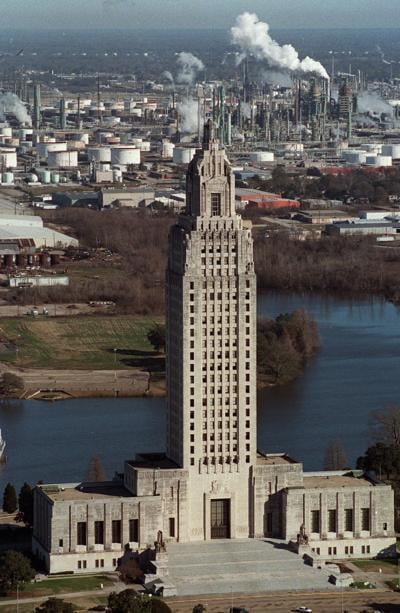
Thousands of years ago, the Mississippi River Delta was formed from sediment deposited from the river. Layers upon layers of sand, silt and clay make up the land that millions of people live and work on today.

But in the past 100 years, Louisiana has lost over 2,000 square miles of land. That’s about the size of Delaware, or the total combined landmass of St. Charles, St. John, St. James, Ascension, East Baton Rouge and East Feliciana parishes.

Man-made levees protect South Louisiana from devastating flooding, but they also prevent the river from depositing sediment to maintain the marshes. Without major action, Louisiana would lose 4,200 square miles of land over the next 50 years, endangering communities and increasing storm surge.

But efforts to halt the erosion are entering a promising new phase over the next four years—one in which the state expects, for the first time since the losses began in the 1930s, to see more land created than it loses. That will come as the Coastal Protection and Restoration Authority (CPRA) shifts from planning massive new dredging and sediment-diversion projects to executing them.

“This is the moment in time in the coastal program that we have been waiting on,” said Chip Kline, the authority’s chairman. “We actually have the political will and the funding necessary to implement these projects that we’ve envisioned for years.”

Chip Kline, chairman of the Coastal Protection and Restoration Authority, said it is now undertaking major projects that it has envisioned for years. Photo courtesy of the Coastal Protection and Restoration Authority

The biggest is the Mid-Barataria Sediment Diversion project, which will help re-create marshes that will provide storm protection to Plaquemines, Jefferson, Orleans and Lafourche parishes.

The project will replace portions of the Mississippi River levee on the West Bank with large concrete gates that can be opened to allow sediment to flow from the river into depleting wetlands, creating tens of thousands of acres of new land.

The sediment from the river also will help sustain land that the CPRA is creating through dredging projects and extend the benefit from the dredging for 60 to 70 years.

Read more at brproud.com

‘It was a ride’: Clay Schexnayder went from racing cars to leading the Louisiana House

Published: March 2, 2021

By: Kathleen Peppo, LSU Manship School News Service

BATON ROUGE — Speaker Clay Schexnayder went from winning races in cars to winning races against career politicians, and the leading Republican legislator in the House was the last person who predicted that sharp curve in his road.

“When I first got elected in 2012, I was the first mechanic and first race car driver to be elected to the House of Representatives,” said Schexnayder, R-Gonzales. “The speaker position didn’t come overnight. It took eight years to get here. It wasn’t something that we set out to do.”

In stark contrast to the many lawyers in the Legislature, Schexnayder trained as a mechanic and has owned and operated Car Craft and Rubber Company Automotive in Sorrento in Ascension Parish since 1998.

The 51-year-old representative graduated from French Settlement High School in 1989 and moved on to study automotive training and computerization at the Allen Institute in Atlanta, where he was certified in Automotive Service Excellence.

‘It was a ride’

Schexnayder got into car racing in 1997, and his last race was in 2013, a year after he was elected to the House.

“I still have the racing bug,” he said in an interview. “Anytime I can go and sit down and watch a race or go to a race I’m there. I’m not a very good race fan because I like to participate, but yeah, I still love it.”

He reminisced about those days, even describing the first accident he was involved in during a race in Pike County, Mississippi.

“I was racing in a big race with a lot of people from all over the country that came to race,” he said. It was only the third or fourth race he had started in a type of car designed for dirt oval tracks. He participated in the Louisiana, Mississippi and Arkansas competition circuit, and in this race, “I was actually doing really well,” he said.

Read more at Shreveport Times

Federal COVID-19 relief could help Louisiana higher education avoid budget cuts this year

Published: March 7, 2021

By: Adrian Dubose and Lauren Cheramie, LSU Manship School News Service

Dr. Kim Hunter Reed, the commissioner of higher education, said Louisiana universities are getting by during the pandemic with the help of increased federal and state funding.
Dr. Kim Hunter Reed, the commissioner of higher education, said Louisiana universities are getting by during the pandemic with the help of increased federal and state funding. Photo courtesy of Dr. Kim Hunter Reed

BATON ROUGE — After losing hundreds of millions of dollars in the COVID-19 pandemic, Louisiana’s public universities are hopeful that three rounds of federal relief packages and a proposed $56 million increase from the state will enable them to avoid budget cuts this year.

Universities and colleges faced significant revenue losses and additional expenses as a result of the pandemic. The LSU, University of Louisiana and Southern systems also had to cope with a $21.7 million cut in state funding last year.

Education officials feared that they were going to lose ground again in the coming budget year after more than a decade of financial instability.

But they are now optimistic that the state will invest more in education and that another aid package in Congress will help keep them whole.

Gov. John Bel Edwards presented his t spending proposal to the Legislature on Feb. 26. He called for a $56 million increase l for higher education, including $19.8 million for faculty pay raises. This would be the first statewide raise in 13 years, though some universities have granted several pay hikes of their own along the way.

Edwards’ proposal also includes full funding for TOPS scholarships, an $11 million increase for the need-based financial aid known as GO Grants and $15.6 million to cover mandated cost increases like pension benefits for retired educators.

“Increasing affordability through a historic investment in need-based aid, raising faculty pay, and improving the stability of our institutions allows our colleges and universities to meet the education challenges of the moment,” Dr. Kim Hunter Reed, the commissioner of higher education for the Louisiana Board of Regents, said in a statement.

Read more at theadvertiser.com

Task force recommends Louisiana auction part of high-speed internet spectrum to service providers, businesses

Published: March 4, 2021

By: Emily Wood

This image has an empty alt attribute; its file name is VOJ6FXWQZNBOFLPLONTU2GQURU.jpg
Photo by: Elise Amendola | AP

BATON ROUGE, La. – A task force has recommended that the state auction part of a high-speed internet spectrum to service providers and businesses instead of using it only for public safety.

The high-speed spectrum could provide faster internet access to rural communities in Louisiana and expand the technological infrastructure in those areas. It also could ease the digital divide between residents who have access to broadband and those who do not.

The Federal Communications Commission allocated 50 megahertz of the high-speed internet spectrum, the 4.9 GHz spectrum, to Louisiana.

The FCC initially allowed the 4.9 GHz spectrum to be used for public safety purposes, but only about 3.5% of the available licenses have been used. So last September, the commission expanded the possible uses of the band.

The Louisiana task force has met three times since then, debating whether it could allow business and consumer use of some of the spectrum without hampering public safety.

Firefighters and police officers around the state expressed concern that public usage of the spectrum could overload the bandwidth, causing miscommunication in an emergency.

During the final task force meeting last week, Michael Renatza, executive director of the Louisiana Sheriff’s Association, testified that he and task force members were able to come to an agreement regarding the allocation of the bandwidth.

Read more at kalb.com