LSU students uneasy as robberies, car burglaries increase

Published: Dec. 27, 2021

By: Alaina A. Alfred, Alejandro Burgos and Taylar R. Green, LSU Manship School News Service

Living in an LSU dorm, Jack Tomeny is used to leaving his car unattended in a campus lot for a few days at a time. One day Tomeny noticed that someone had stolen his backpack from the backseat along with the loose change he had in the car.

Tomeny fell victim to a recurring theme that is making students uneasy not only on campus but at popular student apartment complexes near the LSU campus.

The number of car break-ins reported on campus jumped to 22 during this fall semester alone after falling to just two while students were studying remotely in 2020 and averaging 10 a year in the three years before that.

Baton Rouge Police Department records show that the off-campus apartment areas that many students move to after their freshman years have been averaging 30 to 35 vehicle burglaries a month. And relatively high rates for vehicle and apartment break-ins — and armed robberies — in Baton Rouge as a whole add to the apprehension. 

Some students, like Tomeny, acknowledge being a bit naïve in not taking enough precautions. He left a passenger door unlocked even though the lot was not well lit.

Still, he said, “I was honestly a little surprised that there’s people brave enough to go and check random people’s cars.”

Tomeny did not bother to report the break-in to LSU police, saying that he did not see what they could do at that point and that he decided to “kind of just cut my losses.”

LSU sophomore Laisha Mendez found that someone had broken her car’s passenger seat window in September while she was inside a bar in Tigerland, a popular hangout spot for students. The glove compartment was open, and old checks were found scattered over the seat.

Mendez spoke to the Baton Rouge Police Department about the incident and learned that the police had apprehended two men suspected of committing that crime and 17 other car-related incidents.

Read more at the News Star

College students on the pros, cons of online learning

Published: Dec. 29, 2021

By: Masie O’Toole, Kirby Koch and Donald Fountain, LSU Manship School News Service

Bryce Trum sat up in his twin-sized bed at 6:55 a.m. His day of classes at LSU was about to start at 7 a.m., and his classroom was only five feet away.

a man sitting on a chair
Trum

But as he signed onto the Zoom meeting on his computer, his attention was immediately drawn to his guitar. Six strings on the acoustic guitar leaning up against his eggshell white walls was more enticing than listening to the voice coming through the Alienware laptop on his desk. The instrument created an easy distraction for Trum, and avoiding his online computer science class became second nature.

Trum was not alone as the COVID-19 pandemic thrust college students across the country into the biggest experiment yet with online learning. In a survey of 500 college students across 22 states, a professor at the University of Nebraska-Lincoln found that two-thirds felt they had learned less by having to shift online during the height of the pandemic. Four out of five students said they were more distracted at home than they would have been in a classroom. Other problems included social isolation and difficulties in interacting with other students.

“This was a tsunami that no one saw coming,” the professor, Bernard McCoy, said in releasing the study last July. “Suddenly, it was looming in front of us and washing over us. And so we had to learn how to swim.”

But McCoy also found that as the students got used to going virtual, more than half of them said they would like to have remote learning options available in the future. The students enjoyed the flexibility, saying that they were better able to tailor their schedules to incorporate their jobs and that online instruction saved them time and money.

The shift to online instruction happened suddenly as COVID-19 surged in the spring of 2020, and administrators and professors were just as surprised–and unprepared–as their students for the shift.

Nicole Cotton, a technology specialist at Nicholls State University in Thibodaux, said her school rushed to give professors tips on how to teach in the new environment. “We were doing workshops online when most of our faculty had never taught online,” she said.

Kaci Bergeron, the director of Nicholls State’s Student Access Center, said that the students who struggled the most were deaf and blind ones.

Read more at New Orleans City Business

As industries decline and storms intensify, Louisiana’s small towns shrink

Published: Dec. 22, 2021

By: Caden Lim, Joe Kehrli, Logan Puissegur and Alexander Sobel, LSU Manship School News Service

Every morning, Floyd Dupre and his son, Mike, button up their denim shirts, throw on some jeans and slip into their boots. It’s another day on the farm tending to their cattle.

Meanwhile, 60 miles east in the state’s capital, Floyd’s grandson and Mike’s nephew Joseph Dupre hits the gym near his apartment and heads to class at the state-of-the-art engineering building on LSU’s campus.

Joey Dupre is a chemical engineering student who wants to focus on sustainable energy sources. He aspires to live in Houston rather than take over his grandfather’s farm, and his story is typical for rural Louisiana, where younger generations are leaving for more opportunities in urban areas and other states.

Data from the 2020 U.S. Census shows that 45 of Louisiana’s 64 parishes lost population over the last decade. Louisiana was fifth in the nation for slowest population growth; the only parishes that saw growth were the main urban ones and their suburbs.

Louisiana’s population grew a mere 2.7%, according to Census data. The national average was 7.4%.

Towns in some of the swampland parishes closer to the Gulf of Mexico that rely on the petroleum industry are experiencing a similar loss as the country shifts to more renewable energy sources and storms intensify.

New Iberia residents say, for instance, that their area has been losing people to Lafayette and more distant places as oil-related business declines at its port.

“Out of the six of us, my siblings and my cousins, that could choose where they wanted to live, only one of them lives in New Iberia,” Warner Simon, an LSU student from there, said. “Three of them live in New Orleans, one in Houston and one in Tampa Bay.”

Read more at Daily Advertiser

‘It’s very discouraging’: Louisiana teachers grapple with challenges of ongoing pandemic

Published: Dec. 21, 2021

By: Margaret DeLaney, Olivia Varden and Chris Langley, LSU Manship School News Service

In fourth-grade teacher Laura Spurgeon’s class, the students who attended school in person during the pandemic sit in one area, and those who were online last year sit in another. A third group, the students still working from home, join on a screen.

“It’s like I’m teaching three different levels instead of one,” Spurgeon said. “The students who still stay at home ‘sick’ and have to join via Zoom, the ones that opted for online last year and didn’t learn as much, and the kiddos who have been in person the entire time.”

With the COVID-19 disruptions, standardized test scores for students in grades 3 through 8 have fallen in 69 of 72 Louisiana school districts. State performance scores for schools and school districts, released in early December, fell overall as well.

Teachers, administrators and counselors are trying to figure out how to help many students catch up and get K-12 education back on track. However, they must determine how to reach students who are now performing at different levels while also dealing with the psychological fallout on children who had limited social contact during the shutdowns.

What makes this even harder is that many schools across the state are facing a shortage of teachers. Older teachers are opting for retirement rather than face health risks, and new college education graduates are passing on jobs they view as offering too little pay. 

And the teachers who are still on the frontlines are working harder than ever and reaching out to parents of struggling students through phone calls or emails.

Morgan Story, a high school teacher at MSA West Academy in Plaquemine, said most parents have been understanding and are working with her to help their children.

“They really just needed a voice of a teacher being like ‘All right, I know we’re struggling. This is where we’re at with it, too. This is what you really need to focus on.’ And that helped a lot of parents.”

Read more at Town Talk

Stay or go? Louisiana residents are being forced to face climate crisis threats

Published: Dec. 20, 2021

By: Joe Rizzo, Joey Bullard and Michael Sanders, LSU Manship School News Service

As Hurricane Ida rapidly grew in strength, crabbers Stacia Johnson and Justin Smith were left with just three days to relocate their $100,000 supply of crab traps. Knowing the traps could be severely damaged or stolen if left on land, the siblings dropped their traps in the Biloxi Marsh, said a prayer and evacuated to Arkansas. Days later, unsure how many traps would be left, they found that not only were all of the traps intact, but they were also filled to the brim with crabs.

Johnson called the event a miracle in a string of unfortunate events due to the worsening effects of climate change. Rising water temperatures, disappearing islands and rapidly changing salinity levels have severely altered their fishing routes and the migration patterns of the crustaceans they catch. These changes have significantly hindered their success as commercial fishers.

Siblings Justin Smith and Stacia Johnson on a boat on Lake Pontchartrain.
Siblings Justin Smith and Stacia Johnson on a boat on Lake Ponchartrain. Courtesy of Stacia Johnson

The Johnson-Smith family is not alone. As ocean temperatures rise, hurricane seasons become longer and more intense, and residents across the state are being forced to face the existential threats of the climate crisis.

Since the catastrophic damage from Hurricane Katrina in 2005, people across South Louisiana have faced greater anxiety about what could happen next. And the damage from Hurricanes Ida and Laura has turned that anxiety into dread, once again prompting families who have lived here for generations to reconsider calling Louisiana home.

Dr. George Xue, a marine science professor at LSU, said the Gulf of Mexico is a great conductor of energy for “monster storms,” or hurricanes that reach categories four or five.

Xue said that with rising sea levels and warmer ocean temperatures due to climate change, Louisiana will begin to see more hurricanes that will gain power fast and become even more unpredictable than the five major ones that hit the Gulf region over the last five years.

“There will be no safe harbor from major hurricanes in the Northern Gulf,” Xue said.

A new survey, led by LSU geology professors, of 2,780 scientists studying climate change shows that 91% of them believe that the Earth is warming because of human-related greenhouse gas emissions. Although this number has risen by 10 percentage points since 2009, according to the Pew Research Center, fewer than half of Americans believe that humans are causing climate change.

Read more at Shreveport Times

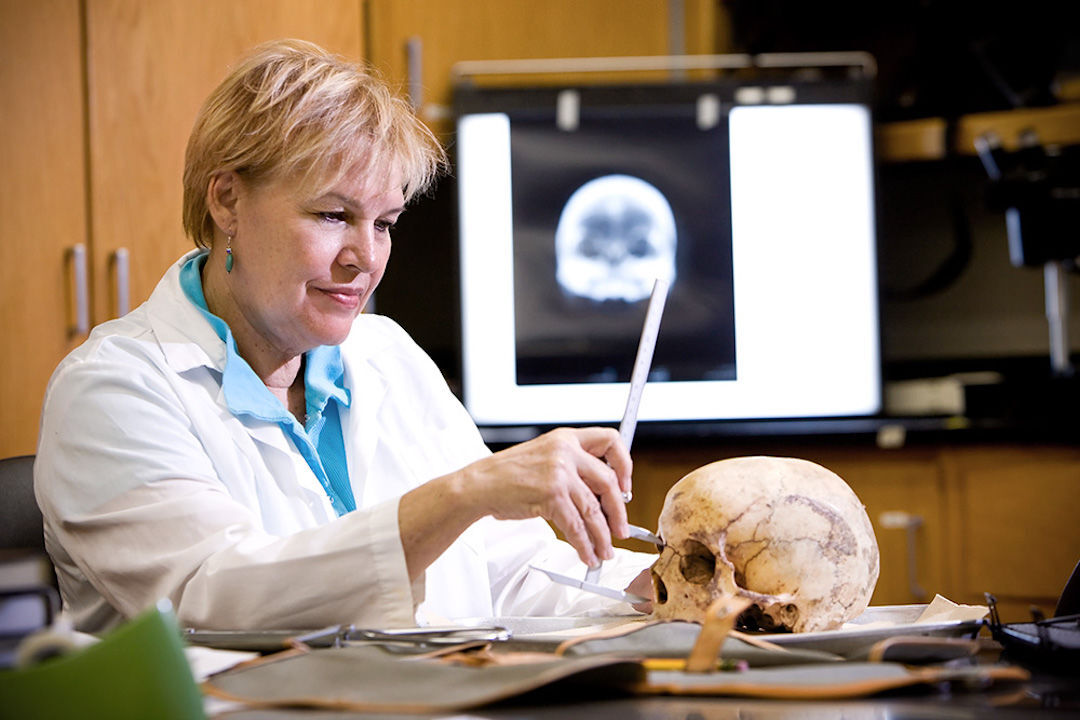
‘The Bone Lady’ — Her cases range from mummies to murders

'The Bone Lady' — Her cases range from mummies to murders
Mary Manhein founded and directed the FACES lab, assisting law enforcement in finding missing persons and human remains. Eddy Perez, LS

Published: Dec. 3, 2021

By: Annalise Vidrine and Shelly Kleinpeter, LSU Manship School News Service

BATON ROUGE — “Can you get me the bone lady?”

Since the 1980s, law enforcement officials from across Louisiana have called LSU for help in identifying human remains and finding missing people. This earned Mary Manhein the reputation as “the bone lady.”

Given that interest, Manhein formed the Forensic Anthropology and Computer Enhancement Services Lab at LSU in 1990 to help law enforcement and coroner’s offices identify missing persons and human remains.

With cases ranging from mummies to murder victims, the FACES Lab provides invaluable services across the state using bones, DNA and other forensic methods to identify missing persons.

FACES was in the news again this October when Sabine Parish officials, building on the lab’s earlier work in identifying a dead man in a well, were able to recover more of the body and make an arrest for a murder that they believe occurred in 1984.

“They were a tremendous help all the way around,” said Detective Chris Abrahams of Sabine Parish, who worked with the lab’s experts on the case. “If they wouldn’t have brought the missing person case to our attention, we would’ve never put two and two together.”

By securing funding from the state and LSU, Manhein, now 77, helped the lab build a national reputation in forensics. She also created the LA Repository for Unidentified and Missing Persons Information Program, the most comprehensive statewide database of its kind.

Manhein retired from the lab in 2015, and Dr. Ginesse Listi, who had worked with Manhein for years, succeeded her and has continued the work.

Read more at The Daily Star

“Trust your dog:” Louisiana volunteer team using search and rescue dogs to help police find missing persons

Kirsten Watson and her German Shepherd Quest getting ready to practice detecting remains. Photo credit: Calista Rodal/LSU Manship School News Service

Published: Nov. 26, 2021

By: Alex Tirado and Calista Rodal, LSU Manship School News Service

SLIDELL, La. — Wading through knee-high waters in the marshes near Slidell, James “Trey” Todd and his K-9 partner are on full alert for any sign of movement. While their mission is to locate the remains of a local man, they are also watching out for the 500-pound beast that bit into him.

In the aftermath of Hurricane Ida, the man Timothy Satterlee, was attacked by an alligator outside his home. Then Satterlee and the gator both vanished.

Todd was one of several members of the Louisiana Search and Rescue Dog team called to search for Satterlee. Todd and his yellow Labrador retriever named Messi Rue crisscrossed the alligator-infested swamps for days, fully aware of the dangers that hid just below the surface.

“I was scared to death,” Todd said.

In that case, wildlife officials found the 12-foot alligator before the cadaver dogs could, and DNA showed that Satterlee’s remains were inside its stomach. But just three weeks later, Todd and Messi Rue were at the forefront of a search for a missing woman.

Leslie Ann Smith had abandoned her car on the side of the road a month earlier in Lamar County, Mississippi. Deputies looked for her in the adjacent woods, but the dog team found her scattered remains, along with a gun that suggested suicide, about a half-mile from the original search perimeter.

Members of the search-and-rescue team, known as LaSAR, have deployed their dogs on more than 600 searches across the country since Lisa Higgins and her daughter Troi-Marie founded the group in St. Tammany Parish in 1991. Working with the FBI and local police agencies, the team has helped solve dozens of criminal investigations by searching for cadavers. It also has rescued missing Alzheimer’s patients and found runaway teens.

As a non-profit organization, the team’s 11 members are all volunteers. Todd is an orthopedist, and Higgins has worked jobs ranging from a law enforcement reservist to a K-9 contractor for the FBI. But they all spend many hours training their dogs to rescue missing people and recover human remains.

Read more at KLFY

‘Everybody lied’: Almost 60 years later, family still seeks answers in disappearance of La. man

Published: Nov. 22, 2021

By: Claire Sullivan and Eternity Honore, LSU Manship School News Service

Six decades after a Louisiana man’s disappearance and presumed murder, his family is still looking for answers and a body to bury.

Carl Ray Thompson, then 26, spotted his cousin’s two-toned Buick on the side of the Ferriday-Vidalia highway as he sat in the back of a sheriff’s car in July 1964.

His cousin, Joseph “Joe-Ed” Edwards, had gone missing just a couple days prior, his family left with only rumors as to his whereabouts.

Joseph Edwards, missing since 1964, is believed to have been murdered by Ku Klux Klansmen and sheriff’s deputies. His case is thought to be the only one investigated by the FBI and Justice Department during the Civil Rights era in which the body has never been found.
Joseph Edwards, missing since 1964, is believed to have been murdered by Ku Klux Klansmen and sheriff’s deputies. His case is thought to be the only one investigated by the FBI and Justice Department during the Civil Rights era in which the body has never been found. Courtesy Of The Concordia Sentinel

Thompson had spent a night sitting in a Ferriday jail cell for a robbery he did not participate in, listening as sheriff’s deputies beat three or four other young Black men arrested for the crime. As the night dragged on, Thompson felt his turn for a beating coming. But morning came, and the arrival of the regular office staff spared him the brutality the deputies reserved for the privacy of night.

As deputy Frank DeLaughter drove the men to the parish jail in Vidalia that morning, he pointed out the green-white Buick, belonging to Edwards, on the side of the highway.

DeLaughter, 6 feet 4 inches and 280 pounds, peered at Thompson through his rearview mirror. He told the men that if any of them spoke about what happened the night before, they would meet the same fate as Edwards.

Read more at the Daily Comet

Victims of Ida can glimpse their recovery journey ahead through the lens of Lake Charles

Published: Sept. 17, 2021

By: Allison Kadlubar, LSU Tiger TV

BATON ROUGE — Lake Charles residents have been trudging through recovery from the catastrophic Category 4 storm Hurricane Laura for over a year.  

“It was just like, this is unreal,” said LSU junior and Lake Charles native Meredith Owen. “It’s so-much-worse-than-I thought kind of thing.” 

Owen is heartbroken every time she returns to her hometown as blue tarps still coat many homes and less than 13% of homes have begun the reconstruction process, according to the city.

“Our house still has a massive hole in the ceiling,” said Owen. 

Just over a year after the destruction of Laura, another Category 4 storm pummeled the Gulf Coast, sparing southwest Louisiana but leaving southeast Louisiana in the eye of the storm. 

“I really thought for a 2-hour window there, when the eye was over us, that we were not going to make it,” said LSU junior Dena Vial. 

Read more at Houma Today

Did the FBI fail in trying to resolve Civil Rights cold cases?

Published: Sept. 16, 2021

By: Liz Ryan and Lara Nicholson / LSU Manship School News Service

Fourth in a four-part series

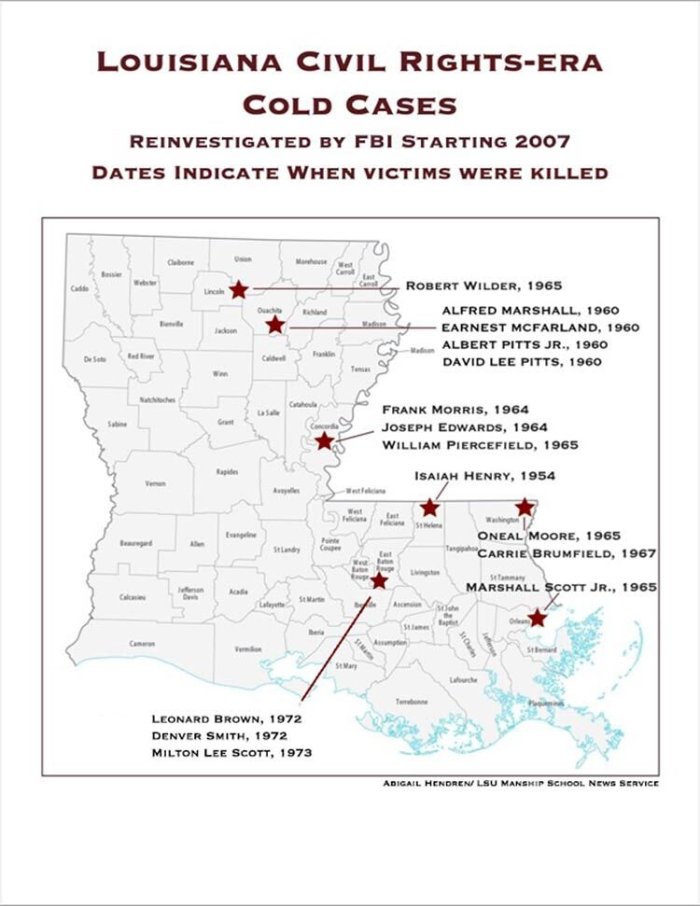
 A retired FBI agent was at a Christian retreat in the late 1990s when a churchgoer confided that he had witnessed a shooting of five Black men in 1960 that he believed had been racially motivated.

And when Congress started to pressure the FBI in 2007 to investigate dozens of cases involving violence by the Ku Klux Klan and other whites during the civil rights era, the retired agent told an active agent what he had heard, FBI documents say.

The case involved Robert Fuller, who ran a sanitation business near Monroe, and his claim to have shot five Black employees in self-defense, allegedly as they attacked him over back pay outside his home. 

A grand jury in Ouachita Parish chose not to indict Fuller, and Fuller died in the late 1980s. But the witness told the FBI that Fuller was “an extremely violent” man who had “snapped” in anger when the workers drove up, and he provided the FBI with a fresh allegation–that he had also seen one of Fuller’s sons shoot some of the wounded men to finish them off.

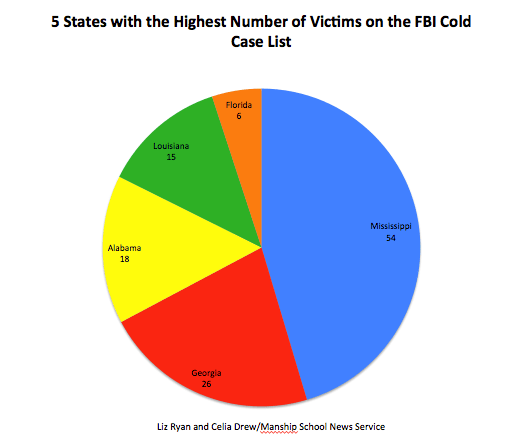
Based on that information, the bureau added the allegation to a list that eventually grew to 132 cases involving the deaths of 151 people, including 15 in Louisiana, that seemed worth new looks.

Under the Emmett Till Unsolved Civil Rights Crime Act, approved by Congress in 2008, the FBI’s main goal was to see if any suspects were still alive and could be prosecuted. 

But as soon as the bureau learned that the Fuller son named by the witness also had died, its interest waned, just as it eventually did in nearly all of the other cases.

And the FBI missed questions, recently uncovered by the LSU Cold Case Project, about whether a different Fuller son who was still alive when the FBI did its work, could have been involved in what happened at Fuller’s house that day. 

Read more at The Concordia Sentinel