Governor’s office proposes hopeful budget with no spending cuts

Published: Feb. 26, 2021

By: Sydney McGovern and Brittney Forbes, LSU Manship School News Service

Governor’s office proposes hopeful budget with no spending cuts
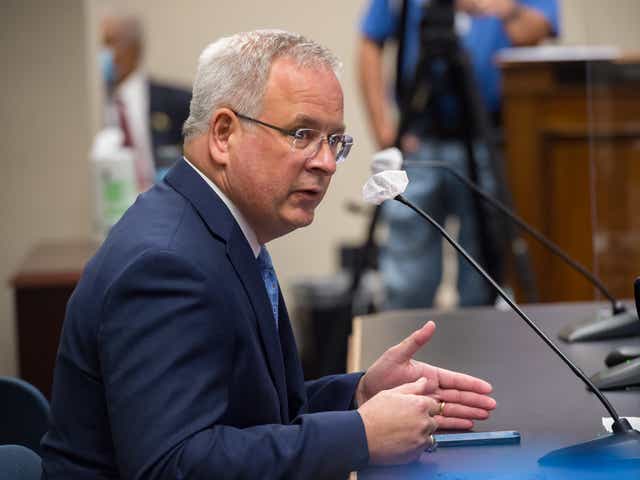
Gov. John Bel Edwards proposes a new state budget with no spending cuts and a small pay raise for teachers. Photo by: Sarah Gamard, LSU Manship School News Service

BATON ROUGE — The Edwards administration on Friday proposed a budget for fiscal 2022 that would use federal coronavirus aid to avoid cuts and provide more funds to K-12 and higher education.

The $36.6 billion budget provides annual pay increases of $400 to K-12 public school teachers and $200 for K-12 support staff, a proposal that teachers unions immediately criticized as too small.

Jay Dardenne, the commissioner of administration, told legislators that the budget also includes a $56 million increase in funding for the state’s higher education system, $19.8 million of which is intended for faculty pay raises.

Besides the increase for higher education, the $186 million in total increases in spending include:

Department of Education: $40 million for the teacher pay raises

TOPS scholarships and GO Grants for Louisiana college students: $23.2 million

Corrections and local housing for inmates: $59.4 million

Governor’s Office of Homeland Security and Emergency Preparedness: $11.5 million

Net change in debt service: $14.3 million

Read more at hammondstar.com

Louisiana’s dependence on federal aid leaves budget picture unclear

Published: Feb. 19, 2021 

By: Sydney McGovern, Brittney Forbes and Cortney Brown | LSU Manship School News Service

dardenne
Commissioner of Administration Jay Dardenne will present a proposed budget to the state legislature next Friday. Photo by: Kaylee Poche | LSU Manship School News Service
Louisiana Budget (copy) (copy)
Louisiana House Appropriations Chairman Jerome “Zee” Zeringue, R-Houma, talks on the phone in this file photo from June 2020. He said the state will be in better shape with more federal aid. Photo by: Melinda Deslatte

With an estimated $2 billion provided to Louisiana from a federal coronavirus aid bill passed in December and the likelihood of another federal stimulus package, state legislators are hopeful they can balance the budget for fiscal 2022 with no more than modest cuts.

The greater concern is the danger of a financial crisis in the following years. Louisiana budget experts project a slow recovery from the pandemic. Federal aid is expected to dry up after this year and many Louisianans have been hesitant to receive the vaccines that could help open up the economy.

Like most states, Louisiana was hit hard by the virus, and the problems were compounded by a catastrophic hurricane season. The state needed nearly $900 million in federal aid approved last March to patch up its finances for fiscal 2020 and the current fiscal year, which ends June 30.

Federal stimulus checks have encouraged Louisianans to spend more, and that has increased the state sales tax revenue beyond original projections. This, along with additional support for higher education and health care in the federal bill passed in December, should make the task of balancing the next budget more manageable.

Jay Dardenne, the commissioner of administration for Gov. John Bel Edwards, plans to kick off the negotiations on February 26 by presenting a budget proposal to the Legislature that includes spending cuts based on current revenue projections.

But the potential for more federal aid is on the horizon. President Joe Biden’s push for a $1.9 trillion stimulus package, which would be the third federal aid bill since the pandemic started, could ease the state’s losses, and put Louisiana in a stronger position for fiscal 2022, which starts July 1.

“It’s anticipated that we get a federal stimulus. If that’s the case, then we’ll be in better shape,” said state Rep. Jerome Zeringue, R-Houma, the chairman of House Appropriations Committee. “Because the economy is in such bad shape right now, we’re hoping we’ll have a similar situation to what we had last fiscal year, and we won’t know that until the federal stimulus package comes in. We’re anticipating it, but there’s no guarantee until it comes. That’s kind of what we need and are depending upon to continue to get us through this crisis.”

Read more at The Advocate

State leaders adopt cautious revenue forecast for 2022

Published:  January 19, 2021

By: Sarah Procopio, LSU Manship School News Service

BATON ROUGE–A cautious revenue forecast was adopted by a panel of state leaders Tuesday as they set income projections used to create the state’s budget.

While the forecast for fiscal year 2022 adopted by the Revenue Estimating Conference predicted a slow economic recovery and more money into the state coffers, it also predicted there will be $228 million less for the state than previously forecast.

Tax collections from the next fiscal year, which starts June 30, will increase by almost $115 million from the projected total for this year. However, that will not be enough to offset the loss of almost $800 million in federal funds. In addition, $90 million from the state rainy day fund used to patch up holes in the previous budget will not be available.

The panel has four members: Commissioner of Administration Jay Dardenne, Senate President Page Cortez, House Speaker Clay Schexnayder and independent economist Stephen Barnes of the University of Louisiana at Lafayette.

“This has been a historically tumultuous time for the state,” said Barnes. “We’re still looking at a lot of uncertainty.”

Some of that uncertainty involves how the latest federal coronavirus relief package, which will provide Louisiana with at least $2 billion in aid, can be used to fill in the budget. The panel is awaiting rules on how that money and an upcoming relief bill proposed by the incoming Biden administration can be used.

Read more at HoumaTimes.com

When will sports betting be allowed in Louisiana? It may not happen this year.

Published: February 10, 2021

By: Ryan Nelsen, Matthew Bennett and Mahogani Counts, LSU Manship School News Service

Sen. Ronnie Johns, R-Lake Charles, sponsored the bill to legalize betting on sporting events in Louisiana.
Photo credit: Sen. Ronnie Johns

BATON ROUGE — Voters in most parishes supported the legalization of sports gambling last Nov. 3, but it may be 2022 by the time bettors are legally allowed to wager in Louisiana on football and other games.

With 55 of the 64 parishes voting in favor of the proposal, legislators will use this spring’s session to set tax rates and create a plan for betting on sporting events.

The Louisiana Gaming Control Board will then create a regulatory model for gamblers and bet takers to use. Mike Noel, the chairman of board, said he expects the rules to be similar to ones that the board recently approved for fantasy sports betting.

Noel said the State Police’s gaming enforcement division will begin taking applications from fantasy sports operators after the rules are published on Feb. 20.

In 2018, voters in 47 parishes approved betting on daily fantasy games in which users create virtual rosters of real athletes and hope they record better statistics than the groups assembled by other players. The gaming board decided last year that it would levy an 8% tax on the net revenue from fantasy gambling to help fund early childhood education. Louisiana was one of only seven states that did not allow fantasy sports betting in 2020.

Louisianans eager to bet on real sports hope that legislators and the board will not take as long to create the rules this time. Sen. Ronnie Johns, R- Lake Charles, sponsored the bill that legalized sports betting, and he expects lawmakers to have a plan before the Legislature gathers in April for a two-month session.

“I will assure you that we will have an agreement between all parties before the legislature in April with the final proposal,” Johns said. “There is absolutely a lot of discussion going on right now, among all parties involved.”

As Louisiana struggles to finance its operations given the economic effects of COVID-19, sports gambling could provide the state with extra revenue and jobs. While a legislative fiscal note written in 2018 estimated fantasy sports betting would generate $375,000 in tax money in the first year, sports gambling could create more.

Read more at houmatoday.com

‘CONCUSSIONS ONCE SEEMED LIKE A PHANTOM INJURY’

Article Image Alt Text
Eric Hill, a former LSU and NFL linebacker, said that concussions caused by head-to-head tackling were common when he played football. Photo credit: Jessica Speziale, LSU Manship School News Service)

Posted: January 27, 2021

By: Jessica Speziale and Henry Weldon, LSU Manship School News Service

This is the second story in a two-part series from the LSU Manship School News Service about the dangers of concussions in high school football games in Louisiana and efforts at schools, universities, and the NFL to make the sport safer.

Back when Eric Hill played linebacker for LSU and in the NFL, every tackler had the same mindset: “You kill the head, you kill the body.”

Hill, who retired from football in 2000, remembers coaches at every level telling him to use his helmet as a weapon. That created a greater risk of concussions for both players. But the NFL was like “the wild, wild West” then, he said, with few safety rules, and concussions seemed like “a phantom injury” since few people were aware of the serious effects.

If a player got his bell rung, he had ammonia packs in his sock to sniff and keep playing.
“You could just grab one, and ‘all right, I’m good,’” Hill said. “That’s how we did it.”

Hill played 11 seasons in the NFL, mostly for the Cardinals in St. Louis and Phoenix. He also was a captain of LSU’s SEC Championship team in 1998. He had seven documented concussions in the NFL, but he suspects he might have had up to 100 throughout his career.

One sticks out in his mind. His team was facing the New York Giants when he scooped up a fumble. Another player came in and hit him on the side of the head. He dropped the ball and then instinctively headed back to the huddle.

“To this day, they were saying it was, like, three plays where I had no idea what I was doing,” Hill said.
The concerns about concussions surfaced after the first case of chronic traumatic encephalopathy (CTE) was found in 2005 in the brain of Mike Webster, a former center for the Pittsburgh Steelers, and they have since prompted efforts to make tackling–and football itself–safer at every level, from youth and high-school leagues on up through college and the pros.

As more brains of deceased NFL players were examined, nearly all came back with the same result: CTE. Many of the players suffered from severe mood swings, and some committed suicide. Former New England Patriots tight end Aaron Hernandez was convicted of murder and, at 27, hung himself in his jail cell in 2017. Researchers determined that he had one of the most severe cases of CTE for someone his age.

Read more at eunicetoday.com

‘I couldn’t move my legs’ The concussion danger in Louisiana youth football

Lance Garafola was treated in a hospital after a concussion left his legs numb. He continued to play football for two more years after his injury. Photo credit: Lance Garafola

Published: January 17, 2021

By: Hunter M. McCann, Keith A Fell Jr., Anthony J. Mocklin, LSU Manship School News Service

The following is a two-part series from the LSU Manship School News Service about the dangers of concussions in high school football games in Louisiana and efforts at schools, universities, and the NFL to make the sport safer.

Chapter One: “I couldn’t move my legs.”

Lance Garafola lay on the turf of a high school football field wondering what had happened and where the feeling in his lower body had gone. The crowd and both sidelines fell silent as trainers rushed onto the field. 

Garafola was a sophomore at St. Michael the Archangel High School in 2016 when a Loranger High player blind-sided him on an onside kick. Paramedics were brought in when Garafola said he couldn’t feel his legs, but they were hesitant to move him because of the possible severity of his injury. Silence and fear hung in the air for over an hour before they raised him onto a stretcher and Garafola threw up his thumb to let his teammates and fans know he was conscious.

He was taken to a local hospital and diagnosed with a concussion. The loss of feeling in the lower half of his body, which lasted for a little over 5 minutes, was created by the concussion and the shock from the hit to his head. 

Nearly every football fan knows that concussions are a serious problem in the NFL and in college games, but less attention has been paid to the dangers facing younger athletes. Experts say high school players also face some degree of risk every time they step on the field. 

The hits are not usually as hard in high school as the one that left Garafola temporarily paralyzed, but medical surveys indicate that 67,000 concussions are diagnosed nationwide among high school football players each year, with many more occurring without being evaluated.

One concern is that few high schools can afford the kinds of sophisticated safety measures that NFL and college teams now take. Garafola and others also say that many high school players are reluctant to report concussions, even when they cause problems like short-term memory loss, for fear of being sidelined for good.

Read more at 4WWL

State leaders adopt cautious revenue forecast for 2022

Photo by Sarah Procopio, LSU Manship News Service

Published: January 19, 2021

By: Sarah Procopio, LSU Manship School News Service

BATON ROUGE–A cautious revenue forecast was adopted by a panel of state leaders Tuesday as they set income projections used to create the state’s budget.

While the forecast for fiscal year 2022 adopted by the Revenue Estimating Conference predicted a slow economic recovery and more money into the state coffers, it also predicted there will be $228 million less for the state than previously forecast.

Tax collections from the next fiscal year, which starts June 30, will increase by almost $115 million from the projected total for this year. However, that will not be enough to offset the loss of almost $800 million in federal funds. In addition, $90 million from the state rainy day fund used to patch up holes in the previous budget will not be available.

The panel has four members: Commissioner of Administration Jay Dardenne, Senate President Page Cortez, House Speaker Clay Schexnayder and independent economist Stephen Barnes of the University of Louisiana at Lafayette.

“This has been a historically tumultuous time for the state,” said Barnes. “We’re still looking at a lot of uncertainty.”

Some of that uncertainty involves how the latest federal coronavirus relief package, which will provide Louisiana with at least $2 billion in aid, can be used to fill in the budget. The panel is awaiting rules on how that money and an upcoming relief bill proposed by the incoming Biden administration can be used.

Read more at Houma Times

Despite our differences, I saw the best of our country while working the polls

LSU professor Will Mari served as a poll worker on Election Day Tuesday, Nov. 3, 2020, in Baton Rouge.
LSU Professor Will Mari served as a poll worker on Election Day Tuesday, Nov. 3, 2020.

Published: Nov. 7, 2020

By: Will Mari, LSU Manship School News Service

The skin behind my ears was burning.

I put some tissue paper behind the cutting elastic holding my mask on tight, and that reduced it to a dull ache. I had been sitting for nearly eight hours and had four hours to go before the polls closed. And I was loving it.

Let me explain.

A few months ago, I was reading a news story about how our local election officials in Louisiana were worried about finding enough people to work as poll commissioners — commonly called “election workers” — due to the pandemic. I’d been wanting to do something to serve my community, “even” something small, and volunteered, taking the online test with the Louisiana Secretary of State and contacting the East Baton Rouge Parish Clerk of Court office.

Many other young people had the same idea, and a number answered the call for help. Last Friday, I got a phone call from Fred Sliman, who works for the Elections Department as a spokesman.

He had received my application and asked where I wanted to work — anywhere close to my precinct in Mid City, in Baton Rouge, I told him, would be great, nervously adding that I was a newbie at all this.

Read more at daily advertiser

Lawmakers reach agreement on bill aiming to lower car insurance rates

Published: June 30, 2020

By:  Catherine Hunt, LSU Manship School News Service

BATON ROUGE – Republican lawmakers and Gov. John Bel Edwards agreed Tuesday to make changes to the state’s civil justice system that could limit damages in personal injury cases in an effort to lower car insurance rates.

The deal, on an issue that was a high priority for Republican leaders, came hours before the special legislative session ended Tuesday.

Both the House and the Senate quickly passed the bill, which was sponsored by House Speaker Clay Schexnayder, R-Gonzales. It was one of several “tort reform” bills written to replace a major Republican-backed bill by Sen. Kirk Talbot, R-River Ridge, that Edwards vetoed.

Edwards will sign the new bill into law, said Matthew Block, Edwards’ executive counsel.

Republican lawmakers, backed by business groups and the insurance industry, pushed hard for what they call tort reform, saying that Louisiana’s litigious climate is why drivers in the state pay the second highest auto insurance premiums in the country, after Michigan.

Democrats, backed by lawyers and judges, opposed the Republican measures to change the legal system, noting that some accident victims will receive less in damages and that there is no guarantee that the legal changes will lead to lower insurance premiums.

Democrats supported legislation that would have prohibited insurance companies from determining rates based on a drivers’ gender, age, credit score or marital status. These bills were killed in committee.

Schexnayder’s was one of several bills that sought to find a compromise between the two sides. It passed in the House 84-16 and in the Senate 35-4.

Read more at WBRZ2


Lawmakers finalize $34 billion state budget on final day of session

Published: June 30, 2020

By: Kathleen Peppo, LSU Manship School News Service

BATON ROUGE–Lawmakers agreed Tuesday on a $34 billion state budget that provides hundreds of millions for businesses hurt by the COVID-19 shutdown but freezes $60 million in pay raises for state employees and cuts funding for colleges that also are struggling financially.

As a 30-day special session was nearing an end, the House agreed to a Senate proposal to temporarily set aside the pay raises for state employees and review in November whether tax collections had rebounded enough to provide them.

If the economy remains stagnant or depressed, the money will be used to fill holes in the budget.

In addition to nearly $800 million in federal coronavirus aid money and the money saved on pay raises, lawmakers also will use $90 million from the state’s rainy-day fund to plug budgetary holes.

Still, the budget, which covers the fiscal year that starts Wednesday, includes cuts in state spending on higher education.

Leaders of the various university systems have said that their costs and lost revenues associated with the coronavirus far exceed the amount of direct aid that they are receiving from the federal government, leaving them in a difficult position.

Read more at houmatimes.com