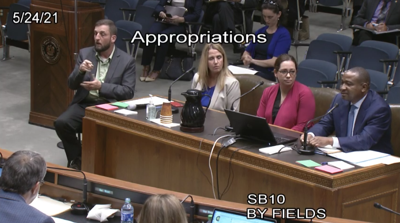
State Sen. Cleo Fields, D-Baton Rouge, right, sponsored legislation to make kindergarten mandatory in Louisiana passed the House Appropriations Committee 19-1 Monday, May 24, 2021.Photo from the Louisiana House
A bill to make kindergarten mandatory in Louisiana passed the House Appropriations Committee 19-1 Monday.
“I have worked tirelessly on this bill,” said the legislation’s sponsor, Sen. Cleo Fields, D-Baton Rouge. “It is the most important one I have worked on during this session. It is something we must do for our children.”
The committee debated whether or not the bill, Senate Bill 10, was necessary since it would only increase enrollment by about 2,800 students, or 4%. That would cost the state and its public schools about $8 million.
Other students affected by the law would attend private schools or be in a home-schooling program.
By: Kathleen Peppo | LSU Manship School News Service
BATON ROUGE — A bill to make discrimination by state entities against people based on whether or not they have been vaccinated against COVID-19 passed the House 70-29 Thursday.
The vote came as faculty members at LSU and other state universities stepped up calls to make the COVID vaccine mandatory for students and staff returning in the fall.
The difference in views illustrates how the COVID vaccinations have become a new partisan flashpoint in Louisiana and other conservative states, much like mask-wearing was earlier.
Rep. Kathy Edmondston, R-Gonzales, said she brought the bill in response to calls from constituents who feared they would be discriminated against if they did not get a COVID vaccine.
“I’ve had numerous calls over the last several months from parents, citizens, but mostly from students who have been required or mandated to take vaccines or testing, that have led me to bring this bill forward,” Edmonston said.
The LSU Faculty Senate voted 52-1 last month to call for a vaccine requirement to help protect unvaccinated staff members and students and people with compromised immune systems. The university has scheduled a meeting for Tuesday that is open to all faculty members to discuss safety issues.
The University of New Orleans Faculty Senate voted 29-0-3 last week to strongly recommend that all faculty members, staff and students get the vaccine.
Three private schools in New Orleans — Tulane University, Xavier University and Dillard University — are among more than 400 nationwide that plan to require COVID vaccinations for students returning in the fall, according to the Chronicle for Higher Education. Roughly 180 of those colleges are public institutions, mostly in Democratic-leaning states.
After the House passed the bill, Rep. Mandie Landry, D-New Orleans, tweeted, “Do I have this right? Discrimination that is ok with #lalege: gender, race, hair. Discrimination that is apparently not ok: refusing a vaccine, wearing a mask, anything to do with guns.”
A bill to allow Louisiana citizens to carry concealed handguns is headed to the full House for discussion. (Source: WVIR)
Published: May 19, 2021
By: Ryan Nelsen | LSU Manship School News Service
BATON ROUGE, La. – Louisiana citizens may soon be able to carry concealed handguns without a permit after a bill passed through the House Criminal Justice Committee Wednesday.
Opponents of the bill, including a police chief and the Louisiana Conference of Catholic Bishops, called for more education than the optional one-hour long course that the State Police will create.
“We’re not against concealed carry. We just believe it has to be supported with education and training,” said Mike Knaps of the Louisiana Chiefs Association of Police.
The bill, SB 118, written by Sen. Jay Morris, R-West Monroe, had nothing regarding training when it passed the Senate but was amended by the House committee to include the optional training. The bill now matches the goal of HB 596, written by Rep. Bryan Fontenot, R-Thibodaux, who sits on the committee. Fontenot’s bill is scheduled for a final vote in the House Thursday.
After lengthy testimony from opponents, Fontenot gave rapid-fire questions to Morris to detail their side of the argument, including that 20 other states have constitutional carry laws and crime has not risen after implementation. Also, Vermont has had constitutional carry since 1790 and is one of the safest states.
The bill states the gun holder may not have a blood-alcohol level above .05 and must notify any police officer who approaches them.
By: Adrian Dubose | LSU Manship School News Service
Photo by: Visit Baton Rouge Courtesy of Visit Baton Rouge
BATON ROUGE—LSU faculty members have stepped up calls for a COVID-19 vaccination mandate for students, and school officials have scheduled a meeting open to the entire faculty next Tuesday to discuss that and other safety concerns.
Faculty members sent two letters to LSU Interim President Tom Galligan and Executive Vice President and Provost Stacia Haynie seeking a requirement that students be vaccinated before returning in the fall. At least 125 faculty members have signed onto the request.
Tulane University announced last week that all of its students will be required to receive a COVID-19 vaccine. It joined Xavier University of Louisiana and Dillard University as the only colleges in the state to mandate a COVID-19 vaccine.
The University of New Orleans Faculty Senate passed a 29-0-3 vote last week on a resolution that strongly recommends that all faculty members, staff, and students at UNO get the vaccine.
The letters from the LSU professors came after its faculty senate voted 52-1 last month to call for a vaccine requirement. The letters cited a growing number of colleges around the country that are requiring vaccines for returning students in the fall.
According to the Chronicle of Higher Education, 380 colleges around the nation are requiring vaccines for next fall, and 179 of them are public schools.
LSU officials have maintained that they could not mandate the vaccines since they have only been approved under emergency use authorizations. Pfizer, however, said recently that it was seeking full authorization of its vaccine from the federal Food and Drug Administration.
Galligan stated in an interview that LSU would consider a vaccine mandate if the vaccines receive full authorization from the FDA–and especially if the Louisiana Department of Health adds the vaccines to its mandatory vaccine list.
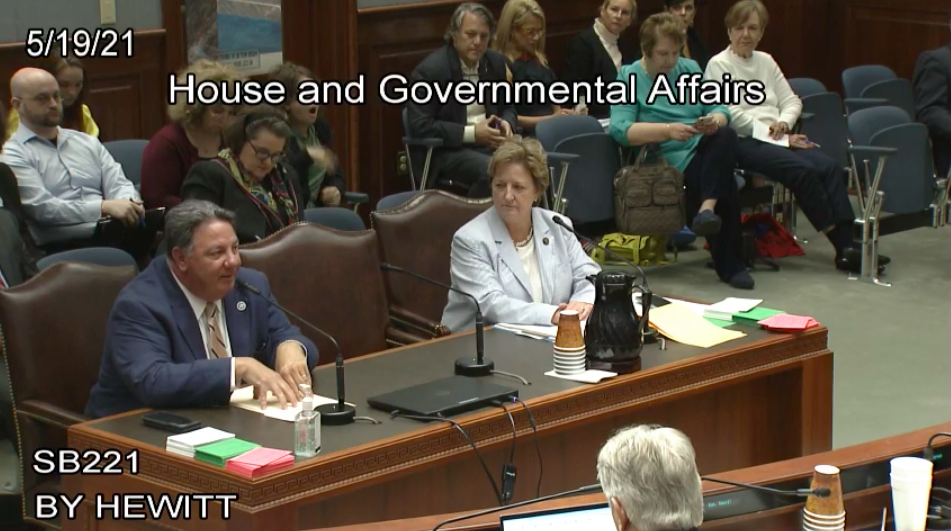
Secretary of State Kyle Ardoin and Sen. Sharon Hewitt, R-Slidell, testified about her bill on buying new voting machines. Photo Credit: Emily Wood/LSU Manship School News Service
BATON ROUGE–Three bills related to voting and elections passed through the House and Senate Governmental Affairs Committees on Wednesday.
Two of the bills–one by Rep. Frederick Jones, D-Bastrop, and the other by Sen. Louie Bernard, R-Natchitoches–would extend the early voting period and create additional provisions for a noncampaigning zone during the early voting periods.
The third, by Sen. Sharon Hewitt, R-Slidell, would mandate the secretary of state to examine voting machines if requested as well as creating certification standards for new voting systems.
Kyle Ardoin, the Louisiana secretary of state, testified on behalf of all three bills.
Hewitt’s bill, Senate Bill 221, also would create the Voting System Commission–a group of 13 members that would research possible voting systems and give a report to Ardoin to guide him on which type of voting system to seek.
Members of the commission would include members appointed by the secretary of state and the governor as well as hired election experts.
SB221 also would create the Voting System Proposal Evaluation Committee that would test the recommended voting systems.
Rep. Royce Duplessis, D-New Orleans, expressed concerns that the election legislation being authored is in response to the Republican dismay over losing the 2021 presidential election.
“There is really nothing that we can look to in the past, that I am aware of, that would lead to this level of distrust in terms of Louisiana’s elections,” said Rep. Duplessis. “I am not aware of anything prior to the November election that brought into question this level of concern of election integrity.”
Hewitt stated that this would be the first time that constituents had the opportunity to express their concerns regarding election systems. She added that she feels like the public bid process for voting systems does not work as well as the process in the private industry.
Sen. Cleo Fields with Sarah Vandergriff and Janet Pope advocating for his mandatory kindergarten bill.
BATON ROUGE, La. — Without taking any action itself, the House Education Committee on Tuesday forwarded a bill making kindergarten mandatory to the House Appropriations Committee to consider its possible $12 million price tag.
Lawmakers said the bill could cost the state that much if there were to be a 6% increase in kindergarten enrollment.
The bill, Senate Bill 10, would require children turning 5 by Sept. 30 of a calendar year to attend kindergarten. Present law does not mandate kindergarten attendance. A child in Louisiana is not required to start attending school until age 7.
“Ninety percent of the brain development happens between birth and age 5,” said bill author Sen. Cleo Fields, D-Baton Rouge.
Rep. Mark Wright, R – Covington, presided over the committee hearing because Speaker of the House Rep. Clay Schexnayder, R- Gonzales, asked House Committee Chairman Rep. Ray Garofalo, R – Chalmette, to step aside as chairman for the remainder of the legislative session.
The Louisiana Legislative Black Caucus asked the speaker to remove Rep. Garofalo in April after his proposed legislation to ban the teaching of critical race theory came out.
“It is the Speaker’s prerogative to choose who he wants to chair a committee,” Garofalo said in a statement on Tuesday. “I have no problem with his exercising his authority, but I will not sacrifice my principles in doing what I know is right. My legislation is about protecting our children.”
The kindergarten bill could keep advancing because the Legislature has lots of money to spend this year. Louisiana is receiving substantial federal COVID-19 relief funds, and the Revenue Estimating Conference projected Tuesday that the state will have over $300 million to spend next year than previously expected.
Any child younger than 5 may enter kindergarten if evaluated and identified as gifted by the Louisiana Department of Education.
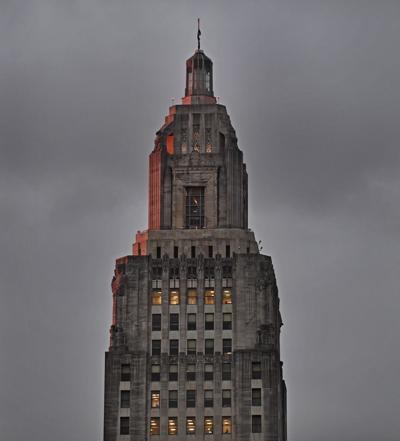
Light from the setting sun illuminates the top of the Louisiana State Capitol Wednesday evening, May 5, 2021, as the light dances across the skyline in downtown Baton Rouge, La.STAFF PHOTO BY HILARY SCHEINUK
Legislation to mandate trauma training for all Louisiana public school teachers, counselors and administrators passed through the House Education Committee Tuesday.
The bill, Senate Bill 211, would require training to recognize the signs and symptoms of traumatic childhood experiences and how to address student needs resulting from the experiences.
“Kids sit in an abusive household for years, and most of the time it is only when an educator or someone outside the home recognizes it,” said bill author Sen. Katrina Jackson, D-Monroe.
The Louisiana Department of Health would offer the training. It would be held during regular training days for teachers and administrators.
Rep. Denise Marcelle, D-Baton Rouge, presented a bill to create an office for women’s health that moved forward in the House Wednesday.(Credit: Kathleen Peppo/LSU Manship School News Service)
Published: May 17, 2021
By: Kathleen Peppo | LSU Manship School News Service
BATON ROUGE, La. (LSU Manship School News Wire) – A bill to create an office for women’s health within the Louisiana Department of Health moved through the House Appropriations Committee on Wednesday.
Rep. Denise Marcelle, D-Baton Rouge, said she brought House Bill 193 to address inequities in Louisiana’s healthcare system.
Marcelle said that when it comes to inequity, “we can always do better.”
“In rural areas, we can make sure that patients do not have to travel as far,” she said. “Whether that is putting a clinic there, putting resources there, getting education to them so they know what they can do to have better outcomes.”
She said it would help to have a specific unit at LDH to address the issues.
Alma Stewart, president of the Louisiana Center for Health Equity and a registered nurse for over 40 years, said she has “seen things not get better but worse, and there’s evidence to support that.”
She said the state’s childbirth mortality rate is among the highest in the nation, and that rate is four times higher for Black women.
She also said in a prior interview that Louisiana is ranked 49th in healthcare outcomes for women and children based on 2020 national data.
By: Kathleen Peppo | LSU Manship School News Service
BATON ROUGE, La. (LSU Manship School News Wire) – The House passed three bills Wednesday to limit access to abortion.
Two of the bills – one by Rep. Raymond Crews, R-Shreveport, and one by Rep. Julie Emerson, R-Lafayette – would make it mandatory to report more information regarding abortions to the Louisiana Department of Health than is currently required.
The third, by Rep. Beryl Amedee, R-Houma, would require doctors to tell women who have begun the process of a chemical abortion that a potential reversal procedure after the first pill in a series of two exists.
After each of the three representatives presented their bills, Rep. Mandie Landry, D-New Orleans, asked, “Has LDH asked you to file this bill?”
Each of the three answered no. The Health Department did not voice opposition to or support for any of the bills.
Amedee’s bill, which she referred to as the “Abortion Pill Reversal Disclosure Act,” requires abortion providers to notify patients who undergo a chemical abortion that the first step in the two-step procedure can potentially be reversed.
A 2017 report by the Health Department revealed that there is insufficient evidence to suggest that any sound method of reversal for a medication-induced abortion exists.
Rep. Aimee Freeman, D-New Orleans, voiced opposition to the bill.
Rep. Hodges, R-Denham Springs, center, advanced two bills to mandate specific civics teachings in Louisiana. (Courtesy Louisiana House of Representatives)
Published: May 12, 2021
By: Emily Wood | LSU Manship School News Service
BATON ROUGE–Two bills that were met with backlashes in the House Education Committee still advanced on Wednesday to the House floor.
House Bill 352, authored by Rep. Valarie Hodges, R-Denham Springs, would require the teaching of the Declaration of Independence, the U.S. Constitution, the Federalist Papers, the Gettysburg Address and the concepts of national sovereignty, American exceptionalism, globalism and immigration policy.
It would retain present law to teach civics as a prerequisite for high school graduation, but these concepts and documents would be mandated in civics classes.
The bill has been controversial, and it became even more so on Wednesday when some legislators felt that an amendment proposed by Hodges seemed similar to a recent bill by House Education Committee Chairman Rep. Raymond Garofalo, R-Chalmette, that would have prohibited any teaching that the United States or Louisiana is systematically racist or sexist.
His bill was shelved after protests by members of the Louisiana Legislative Black Caucus. On Wednesday, Garofalo did not chair the hearing but instead came in and out of the room to vote.
Hodges’ amendment would have prohibited the Louisiana Education Department from approving materials that would teach “that a particular sex, race, ethnicity or national origin is inherently superior or inferior to another.”
That amendment failed on a tie vote, but the overall bill passed 8-5. Garofalo voted for the amendment and the bill.
“I truly do not understand how the chairman can be in another room and not presiding and then come in the room to vote,” said Brass, a member of the Legislative Black Caucus.
The committee also approved another Hodges bill, House Bill 416, that would mandate the instruction of World War II and the Holocaust to middle school and high school students. It would include mandated training to teachers instructing students on such history.
The bill would call on schools across the state to partner with the National WWII Museum in New Orleans to teach the curriculum.

![items.[0].image.alt](https://ewscripps.brightspotcdn.com/dims4/default/e19cf92/2147483647/strip/true/crop/738x415+0+34/resize/1280x720!/quality/90/?url=https%3A%2F%2Fmediaassets.katc.com%2Fcordillera-network%2Fwp-content%2Fuploads%2Fsites%2F3%2F2018%2F10%2F02170012%2Fparade-grounds.jpg)