Education takes priority in governor’s proposed $32 billion state budget

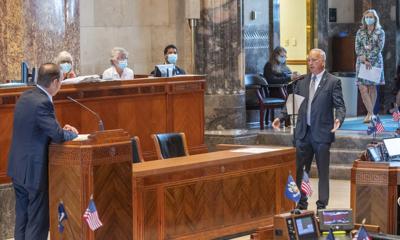
Commissioner of Administration Jay Dardenne presented Gov. John Bel Edwards’ proposed state budget Friday at a hearing in the Capitol.(Photo Credit: Elizabeth Garner)

Published: February 8, 2020

By: Hailey Auglair and Evan Saacks, LSU Manship School News Service

BATON ROUGE—Gov. John Bel Edwards proposed a $32 billion state budget Friday focusing on education as a high priority, with increases in funding for early childhood, K-12 and higher education, including TOPS scholarships.

The budget, for the 2020-2021 fiscal year beginning July 1, was presented by Jay Dardenne, the commissioner of administration, to the Joint Legislative Committee on the Budget. It marks the beginning of negotiations that will play out in the legislative session starting in March.

The governor proposed increasing spending by nearly $285 million overall. But lawmakers will not be asked to raise any taxes this year, Dardenne said.

“This increase to higher education is a very significant investment,” Dardenne said.

It would increase early childhood funding by more than $25 million and higher education by nearly $35 million. It also would boost the money for TOPS scholarships by $5.56 million as more students have become eligible.

However, these increases are dependent on about $100 million in funding that is not currently available because Edwards, a Democrat, and the new Republican leaders, House Speaker Clay Schexnayder and Senate President Page Cortez, have not been able to reach agreement on an official estimate of what the state’s revenue. The Republicans proposed using a lower forecast than Edwards.

As a result, Dardenne said the administration viewed its proposal as a starting point for negotiations.

Despite Edwards’ promises for teacher pay raises during his re-election campaign, there is no funding explicitly allocated for them. Dardenne said the K-12 could use some of the increased funding for pay raises, but it would be up to local districts to decide what to do.

The proposed funding for higher education is still not as high it was nearly a decade ago, but the total has been steadily hiking back up since 2016 when the state faced an overall $2 billion budget shortfall.

Edwards’ proposal includes a $10.9 million increase next year in statewide adjustments to fund mandated costs, like retirement benefits for university staff.

Sen. Bret Allain, R-Franklin, said this increase would greatly benefit smaller schools that have struggled to pay these costs.

“This is the No. 1 budget problem at Nicholls State University, McNeese State and a lot of these smaller universities,” Allain said. “We’re actually paying more in mandatory costs back to the state than we’re getting. The argument’s been made we’d be better off separated from the state.”

Read more at the Shreveport Times.

River flood issue discussed at Iowa caucus

Many homes in Hamburg, Iowa remain unsafe to occupy, with the spring's major flooding posing risks of abrasions, food contaminations and mold exposure. (Photo credit: Olivia Sun/ Des Moines Register)

Published: February 5, 2020

By: Rachel Mipro, LSU Manship School News Service

DES MOINES, Iowa—The Quad City River Bandits had an impossible time drawing a crowd opening night last spring. Its minor league ballpark was surrounded by water two-stories high after the Mississippi River overran its banks and flooded downtown Davenport. With flooded streets and walkways, the team was forced to play elsewhere in Iowa and gave up nearly two dozen home games.

But the team was not alone. Many areas across Iowa, which is bordered by the Missouri River in the West and the Mississippi in the East, had been rendered unusable by rising waters.

Days before the Iowa caucuses on Feb. 3, infrastructure and flooding are a top concern for Iowans, especially after 50 Iowa levees were breached in 2019, and the outlook for this spring is not much better.

In Davenport, the third-largest city in Iowa, nothing prevents the Mississippi River from sweeping in. There are no permanent flood walls or levees guarding the water and no firm plans in place, even after the April flooding, to build some. Water infrastructure is lacking, leaving citizens scrambling for support against worsening environmental conditions.

Standing outside in line for presidential candidate and businessman Andrew Yang’s event in Perry, landscape architect-in-training Natalie Jensen talked about her experience with flooding. Jensen, who’s worked at the firm Confluence since her graduation from Iowa State University, said that they are designing around flood risk like using permeable pavers and porous materials to reduce standing water.

“Des Moines especially has been more aware of it,′ Jensen said. “Omaha, Nebraska, has been very affected by it. It totally tore out a part of the interstate highway,” she said.

Jensen said her uncles and cousins who are farmers, lost significant portions of their crops, and are being careful where they will plant now to avoid a chance of flooding.

According to the Iowa Flood Center at the University of Iowa, there are several initiatives aimed at reducing flooding. One of these is the Iowa Watershed Approach, which focuses on nine district watersheds in Iowa. Each site, from the Upper Iowa River to North Racoon River, will develop their own hydrologic assessment, watershed plan and flood resilience programs.

The ultimate goal is to use the information to create a wider plan for Iowa, its neighboring states and other communities affected by flooding.

At a national level, politicians from Sen. Cory Booker (D-NJ) to Sen. Bernie Sanders the independent of Vermont, have spoken on these issues in Iowa, reiterating their support for the Green New Deal and rebuilding infrastructure in an attempt to reach voters.

Read more at Plaquemine Post South.

Joe Biden’s Iowa campaign ‘consistent’ but uneven, supporters say

(Photo Credit: WWLTV)

Published: February 3, 2020

ByLara Nicholson, LSU Manship School News Service

DES MOINES, Iowa—Just as on the national debate stage, Joe Biden’s campaign appearances in Iowa can be uneven. He can exude experience and expertise. He can appeal to America’s best instincts. Or he can also get lost in his long-winded answers that can wander on and extinguish whatever excitement he and his crowds can muster.

With caucus night on Monday, Feb. 3, the former vice president has had Iowa much to himself since the Senate impeachment trial tied up Sens. Amy Klobuchar of Minnesota, Bernie Sanders of Vermont and Elizabeth Warren of Massachusetts. But how well Biden has capitalized on the moment is as unpredictable as his rally performances.

Just how unpredictable can a veteran campaigner be? In early January, as Biden was gearing up for a month of Iowa campaigning, Biden showed his two sides. One was the knowledgeable former vice president and senator; the other was a tired, aging politician who didn’t bring much passion to the stage and generated even less among a sleepy crowd.

The long-winded Biden showed up several weeks ago at what became a dismal performance in a Des Moines elementary school gym. At a rally scheduled for 7:30 p.m. — late by Iowa standards — he showed up nearly two hours late to a crowd that was literally standing around, mostly without chairs, boxed in by hard, bright white gym walls, few windows and little room to breathe.

Without apology, Biden plowed ahead with a 20-minute speech, covering everything from the values his grandfather taught him to a superficial, three-soundbite plan to fix the country: restore the soul of the nation, rebuild the middle class and reunite the country.

“Putting America first means putting America last,” Biden said on more than once.

Each topic faded into the next, with no punchline for voters to take away.

Then came the questions, of which he managed to take only three before the evening ran past 10 p.m..

The first question was straightforward regarding the vaping epidemic in the country, and Biden took only two minutes to answer.

The next was slightly more involved regarding the Gulf War and Osama Bin Laden. For that he placed all fault on former President George W. Bush in a quick six minutes to answer.

“We will follow Bin Laden to the gates of hell if we have to,” he quoted Obama’s staff as saying.

The final question was from a 14-year-old boy who wanted to know how Biden would create more equality in education.

That answer lasted for 11 minutes, in which Biden vowed to fire Betsy DeVos, Trump’s education secretary, address mental health care in schools and provide free degrees from community colleges before ending with what Biden described as the rise of a fourth industrial revolution. Each topic was freighted with statistics, quickly causing some attendees to lose interest and even doze off.

“Early education is a kite string that lifts our national ambition,” he said along the way.

Read more at WWLTV.com.

What I saw at a Trump Rally: an LSU journalism prof’s impressions

Election 2020 Trump (Photo Credit: AP Photo/Charlie Neibergall)

Published: February 3, 2020

By: Will Mari

DES MOINES, Iowa — “Do you want some of my beef jerky?” asked the man, a producer for Vice Media.

The risers were shaking in the indoor stadium at Drake University, as we waited for the arrival of President Trump at the Knapp Center on a cold Thursday night ahead of the Monday caucuses in Iowa. The salty smell of popcorn and hotdogs from the concession stands was wafting into one of two designated press areas, and I had said aloud that I was hungry.

I told him no thank you, but appreciated the offer—I had heard from friends and other colleagues that the experience of attending a Trump rally could be challenging for reporters, but I went back to my note taking feeling more assured.

A few minutes later, an alumna from our program came over to say hello—she had noticed my purple LSU hoodie poking out from under my blue sports coat. We talked for a few moments.

I explained I was there to work on a research project on how journalists pick their sources. She gave me her card and some tips, and wished me luck. I must have looked a little nervous. I had covered political rallies before, but this felt different.

Below, Jeff Kaufmann, the state’s GOP party chairman, was firing up the crowd. They roared their approval.

Kauffmann, who has a Ph.D. from the University of Iowa, referred to himself as “Dr. Deplorable” — he’s taught history and government at Muscatine Community College. My ears perked up a bit at that—I had gone to a community college, too, and could identify with being told I wasn’t capable, or smart.

A source once told me to my face that my stutter meant that I’d never work in journalism.

Like Kauffman, I come from a military family — and I have served in the military (though I should note here that my opinions are my own). Like Kauffman, I am an academic, working an assistant professor of media law and history at the Manship School at LSU.

After he left the stage, the strains of “Norma Jean,” “The House of the Rising Sun” and “YMCA” blasted the arena, as my fellow media types prepped their cameras and typed up stories, taken from interviews in the milling crowd below, more than 7,000 strong.

When Vice President Pence arrived, I made my way down to the floor, and found an awkward spot among a sea of tripods and microphones in the other media “pen.”

Even as senators back in Washington, D.C., were debating the admission of witnesses and still in the midst of questions for his impeachment trial, the President came on. The crowd’s rumble grew to a crescendo. That, combined with the supercharged soft rock, shook my worse-for-the-wear portable keyboard, its “5” key long since broken.

Read more at WWLTV.com.

Is fertilizer runoff in central US causing Gulf of Mexico ‘dead zone’?


Published: January 17, 2020

By: Sarah Procopio and Rachel Mipro, LSU Manship School News Service

DES MOINES, Iowa—Tom Rendon came here to a Sen. Bernie Sanders presidential campaign event and handed out stickers that said, “Water is Life.”

Rendon has been a member of Iowa Citizens for Community Improvement for over 20 years. The group works on immigration, trade and environmental issues including pollution from large farms that the group believes contaminates the Mississippi River to the Gulf of Mexico.

For Rendon, the hypoxic waters, or “dead zone” problem at the mouth of the Mississippi, is caused mostly by corporate farming and runoff of nitrate fertilizer in Iowa and other states. His hope is that Sanders, the Vermont independent, will have the vision as president to address complex agricultural and environmental problems.

Six months ago, the dead zone was about the size of Massachusetts. Its waters have little or no oxygen and it is killing fish and other organisms, endangering the livelihoods of those who depend on the Gulf’s seafood.

Adam Mason, state policy director for the Iowa citizens group, said it worked with a lot of communities to stop construction of “factory farms” and combat the pollution he says they produce. According to Mason, Iowa is No. 1 in U.S. hog production with more than 26 million hogs generating over 22 billion gallons of liquid manure that’s dumped untreated onto Iowa farm fields and can runoff into waterways.

“This liquid manure, in addition to having lots of harmful bacteria, has nitrates and phosphorus, so we see that as a significant contribution to both the water crisis we have here in the state of Iowa as well as the dead zone,” Mason said.

The Iowa Pork Producers Association believes there is no science to support the claim that pork farming has any relation to the dead zone in the Gulf, according to Dal Grooms, the communications director.

But in 2018, a group of university studies collaborating with the National Oceanic and Atmospheric Administration attributed the dead zone to nutrient pollution. One study, by the University of Michigan, concluded that “the Gulf’s hypoxic zone is caused by excess nutrient pollution, primarily from human activities in the watershed, such as urbanization and agriculture,” it said in a statement.

University of Iowa researchers concluded that Iowa was responsible for a large portion of nitrate pollution using data collected from 1999-2016.

The study said Iowa contributed “between 11% and 52% of the long-term nitrate load to the Mississippi-Atchafalaya Basin, 20% to 63% to the Upper Mississippi River Basin, and 20% to 89% to the Missouri River Basin, with averages of 29%, 45% and 55%, respectively.”

Read more at The Daily Advertiser.

Watch: Presidential candidates say ‘Geaux Tigers’ while on campaign trail in Iowa

(Video Credit: Alyssa Panepinto)

Published: January 11, 2020

By: Lara Nicholson and Abigail Hendren, LSU Manship School News Service

DES MOINES, Iowa—Most college students spend their winter vacations enjoying a reprieve from classes and work.

But about 30 Louisiana State students and faculty invaded Iowa, crisscrossing 1,500 miles to see Democratic presidential candidates campaign before the February 3 caucus.

Still, the national college football playoff, slated for Monday night in New Orleans, was never out of mind. LSU students weren’t shy about asking several candidates for a “Geaux Tigers!” cheer.

Even Joe Biden, whose daughter went to nearby Tulane University, did what it takes to win over LSU Tiger fans.

“I’m going to get in trouble,” the former vice president grumbled.

“No, you’ve got to do it,” an LSU student insisted.

“Alright. Geaux Tigers!” he said, somewhere between a mutter and a shout.

Read more at The Advocate.

Candidate ‘quirks’ help them stand out ahead of Iowa caucus


Published: January 10, 2020

By: Allison Kadlubar, LSU Manship School News Service

DES MOINES, Iowa—Presidential candidates flock here months before the Democratic caucus to gain attention and to get Iowans to stand in their corner on caucus night Feb. 3.

TV ads flood commercial breaks; T-shirts and buttons are given out or sold at most events. But lesser-known candidates need more to stand out.

Andrew Yang, a tech and education entrepreneur who trails in the polls, offers hats, beanies and pins emblazoned with “MATH.” meaning, “Make America Think Again.” He also hands out copies of his book, “The War on Normal People,” to explain the economic disruption from technology and automation he talks endlessly about.

Tom Steyer’s hedge-fund billionaire status makes him a curiosity in unflashy Iowa and his ubiquitous plaid tie and colorfully-woven fabric-and-leather belt helps him stand out a little more. The green-and-red plaid is like a logo he wears to events and debates. He includes it on free koozies and even on the back of his campaign bus.

Pete Buttigieg, who just finished eight years as mayor of South Bend, Indiana, offers “Boot Edge Edge,” stickers to help voters pronounce his name.

Many Iowans are accustomed to questioning candidates as well as shaking hands.  Selfies began appearing four years ago. But Sen. Elizabeth Warren of Massachusetts takes them to a new level. In her carefully-planned selfie assembly line, lines form, Warren stays put and grins, a volunteer takes coats and purses and sets up the picture. Warren shook the hand of each person and told them, “I’m so happy that you came,” or “it was so nice to meet you.” When it’s over, aides zoom in with the crucial question: “Are you ready to caucus for Senator Warren?”

Knowing that politicians are chronically late, Sen. Warren, who makes a point of mentioning she is a mom and a former elementary school teacher, offers coloring pages and markers to occupy children. One little girl sitting on the floor of a rally in Davenport, Iowa, scrawled “Go Warren” with her Crayons, while her mom listened to the candidate.

Sen. Cory Booker, the New Jersey Democrat, gives each attendee a front-facing camera selfie and takes questions or listens to ideas. After a conversation with an elderly woman at a coffee shop event in Creston, Iowa, he leaned in, gave her a hug and said, “Thank you for coming.” She looked up at him with a gleaming smile.

Read more at The Daily Advertiser.

Medical marijuana only option for child with seizures

02MARIJUANA Photo 1 Corkerns.png

Published: January 8, 2020

By:

Katie Corkern is a mother of three sons in Amite. One of her sons is Connor, 13, who has a birth defect in his brain. For most of his life, he has experienced between 50 to 200 seizures each day.

He is unable to function independently and suffers damage to his brain, liver and other organs from his array of anti-epileptic medications.

“His neurologist had come to a point where we were just at a loss,” said Corkern. “We tried so many different medications, we tried surgeries, we did diets, and nothing was really relieving him from the constant seizure activity in his brain.

“At that point, he was on seven different anti-epileptic seizure medications,” she said. “The side effects were devastating, along with the constant seizure activity. At some point, the doctor said, ‘Well, the last thing I would recommend is medical marijuana, but that’s not legal here in Louisiana.’”

Thus began Corkern’s journey, along with state Sen. Fred Mills, R-Parks, and many other advocates to legalize medical marijuana in Louisiana. That happened in 2016, but the therapeutic use of marijuana is just gaining momentum here after a slew of delays and regulatory setbacks.

Roughly 3,500 patients in Louisiana are using it, mostly to relieve pain, and some see it as a substitute for highly addictive opioids. And with more supporters of the program joining the state Legislature this year, it may be expanded to provide greater accessibility statewide.

For Connor Corkern, using medical marijuana has lessened some types of seizures by 75 percent, according to his mother, along with giving him the ability to now clap and express emotions.

The average age of medical marijuana users in the state is 52, and the most common condition is intractable pain. Thirteen percent of users are PTSD patients, while 26 percent of the patients are recovering opiate users.

Mills said that “folks tell me, ‘I was on opioids, and now I’m on medical marijuana. I’m not having the side effects, and I’m more productive.’”

The state has approved two facilities to grow marijuana for medical use: the GB Sciences Louisiana location at the Louisiana State University Agricultural Center—recently bought out by Wellcana Plus LLC— and Ilera Holistic Healthcare at Southern University.

Licensed doctors recommend marijuana to patients rather than prescribe it to protect themselves from federal laws that prohibit the use, sale or distribution of marijuana. The patients may receive their medication through a 30-milliliter tincture, which is a concentration dissolved in an alcohol solution for oral consumption.

Tinctures are made with cannabinoids THC, or tetrahydrocannabinol, and CBD, or cannabidiol. THC combines with receptors in the brain that control mood and pain to create a sense of euphoria in users. CBD creates no “high” for users but increases attentiveness, lowers anxiety and relieves inflammatory pain.

Read more at The Ouachita Citizen.

Despite trade war reprieve, soybean farmers fear irreparable damage, lasting tariffs

(Photo Credit: David Mead via MGN)

Published: January 8, 2020

By: Caleb Greene, LSU Manship School News Service

BATON ROUGELouisiana’s soybean farmers, still reeling from tariffs and low prices, experienced a win in December when President Donald Trump announced China had agreed to purchase $40 billion in U.S. agricultural products over the next two years. Skeptics though have found little comfort with the deal and worry about long-term harm to the nation’s farm economy.

The deal, expected to be signed on January 15, will double China’s commitment to American agricultural products and complete phase one of trade negotiations between the two countries. Soybean farmers fear China’s reluctance to honor the deal and the damage caused already by the administration’s protectionist trade policies.

“It’s a warranted concern that extends beyond Iowa’s soybeans,” said Michael Dolch, public affairs director for the Iowa Soybean Farmers Association. “Commitments up to this point haven’t always been held up by China. Commitments are different than assurances.”

Total U.S. soybean exports have declined 29 percent to $16.9 billion in 2019 since a $23.8-billion high in 2017, according to the Agriculture Department. Though China has committed to increasing its agricultural purchases, the phase one agreement will not remove the 25 percent tariff on U.S. soy products, a top concern for soybean farmers.

“It has taken decades to develop these relationships [in China],” said Daryl Nelson, a farmer from Greenfield, Iowa who grows soybeans with his son. “It’s a market that now we’re fearful will go to Brazil. It’s questionable if we’ll ever regain that.”

The decline and ongoing trade war have particularly hurt Louisiana due to the state’s status as an export market. Louisiana’s farmers have received $180 million in federal aid to compensate for losses, 75 percent of which went to soybean growers. Louisiana’s soybean farm value is $800 million, making it the state’s second major agriculture product behind sugarcane.

“Hopefully we get back to the business of old,” said Kyle McCann, assistant to the president at the Louisiana Farm Bureau. “When your No. 1 leaves, we [Louisiana] are impacted a little disproportionately as an export market.”

Read more at KALB.com.

Trump, Sanders and Warren have more in common than you might think

(Photo Credit: Stacey Tinsley/Press-Tribune)

Published: January 7, 2020

By: James Smith, Abigail Hendren, LSU Manship School News Service

DES MOINES, Iowa—President Trump has disrupted American politics since he announced his candidacy in 2015. He uses abrasive language, dismisses Washington’s political establishment and has shifted his party further to the right.

So have Bernie Sanders and Elizabeth Warren and they are among the leaders here. The two do not use Trump’s caustic rhetoric, but they are disruptors nonetheless. Like Trump, they have cast themselves as combatants for the have-nots, and they are pushing the Democratic party further to the left by insisting that American health care, banking and trade, to name just three, are not working for everyone.

Warren, Sanders and Trump say they despise the traditional politics of Washington. They claim the system does not work for the average American. Sanders and Warren’s campaigns are geared toward the working class, young voters and those who struggle to make ends meet under crippling costs of healthcare and student debt.

Trump, who handily won Louisiana in 2016, targets working class voters who feel as though they are overlooked among the mess of bureaucracy. In short, all three claim their policies are in the best interests of ordinary Americans as opposed to the Washington establishment interests of politicians and the wealthy.

Although the two Democratic senators vehemently oppose Trump, they are, in a way, his left-wing equivalents. All three share a common, timeless ethos: disrupt the system.

“If you could close your eyes and there weren’t accents,” David Redlawsk, a political scientist at the University of Delaware, said, “you might not be able to tell the difference.”

All three disregard traditional niceties of the political elite. As “outsiders,” they promise to overhaul Washington and reform American society. They make these promises with volatile rhetoric to excite crowds.

Some Iowans, like Tiffany Mitchell, 43 and uncommitted to any candidate, feel as though an outsider is necessary in Washington.

“I like the idea and the concept of [an outsider] but I also want someone who knows what they’re doing, unlike Trump,” Mitchell said, at a rally for Andrew Yang, another outsider. “I do get the outsider concept. I do like it…for me, it’s more of the overall package versus ‘he’s an outsider so I’m going to vote for him regardless.”

Read more at the Bossier Press-Tribune.