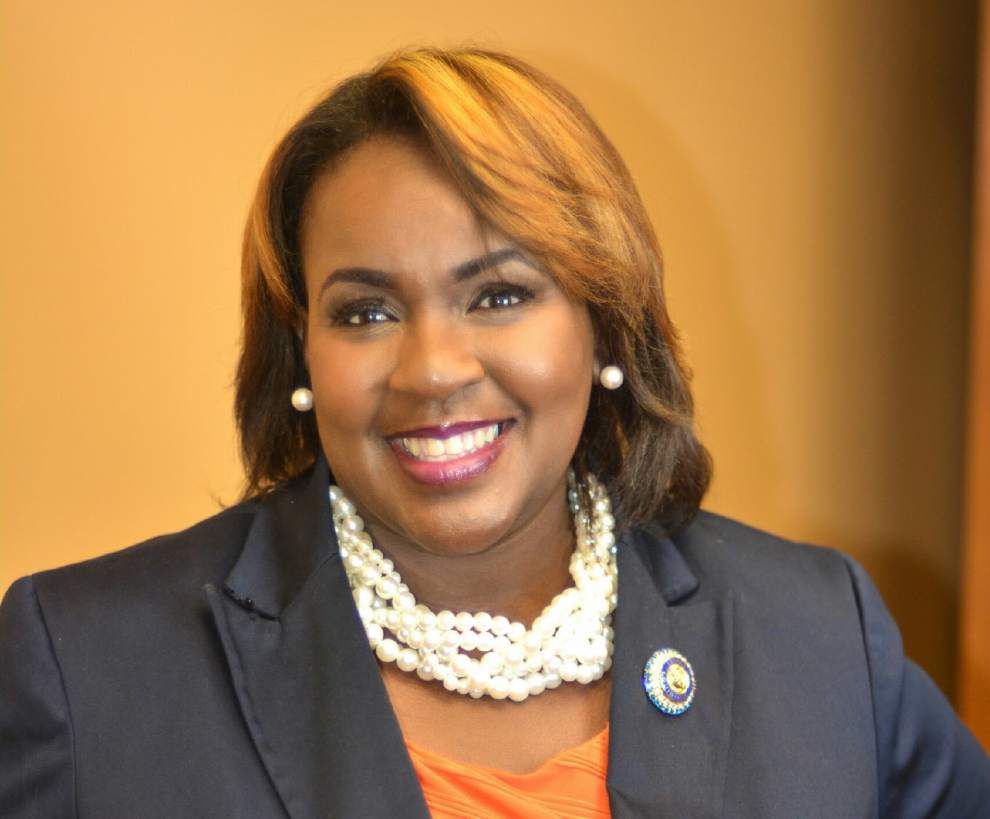
Rep. Sam Jenkins, D-Shreveport, sponsored a bill to provide $250 stipends to front-line workers during the COVID-19 shutdown.
Published: June 29, 2020
By: Kathleen Peppo, LSU Manship School News Service
BATON ROUGE, La. (LSU Manship School News Service) – Legislators voted Monday to provide one-time payments of $250 to front-line workers during the COVID-19 stay-at-home order and to protect schools and colleges against lawsuits that could arise if students or staff-members contract the virus. The $250 stipend passed by unanimous votes in both chambers. The bill, sponsored by Rep. Sam Jenkins, D-Shreveport, now makes its way to Gov. John Bel Edwards, who has already voiced his support.
Under the bill, up to 200,000 public and private workers will be eligible to receive a check. To apply, the worker must make $50,000 a year or less. He or she also must have worked at least 200 hours in an essential job, such as in a grocery store or a nursing home or as a first responder, while the stay-at-home order was in effect from March 22 to May 14.
The bill will use $50 million of the state’s $1.8 billion in federal coronavirus aid funds.
In response to the financial crisis created by the COVID-19 shutdown, Republican lawmakers slated $300 million of the federal relief dollars to provide grants for Louisiana businesses and $565 million to provide aid to local governments.
The Senate passed a proposed compromise bill by Rep. Richard Nelson, R-Mandeville to lower auto insurance rates.
Published: June 29, 2020
By: Catherine Hunt, LSU Manship School News Service
BATON ROUGE, La. (LSU Manship School News Service) – With the special session nearing an end, the Senate passed two possible compromise bills Monday aimed at lowering auto insurance rates and winning support from Gov. John Bel Edwards, who vetoed a major Republican-backed tort reform plan. The Senate voted 30-8 to approve a bill by House Speaker Clay Schexnayder, R-Gonzalez. Another bill, by Rep. Richard Nelson, R-Mandeville, passed 35-3, with seven Democrats voting in support. The House passed Nelson’s bill 82-9 last week, with 21 Democrats voting for it.
House Speaker Clay Schexnayder
Stephen Waguespack, head of the Louisiana Association of Business & Industry, told The Advocate/The Times-Picayune that his group was fine with either Nelson’s or Schexnayder’s bill.
The vetoed bill was proposed by Sen. Kirk Talbot, R-River Ridge. It would have limited damages awarded to plaintiffs in personal injury cases in an attempt to lower auto insurance premiums.
Louisiana has the second-highest car insurance rates in the country, after Michigan.
Republicans have not been able to muster the votes to override Edwards’ veto, and have focused on passing replacement bills or resolutions while negotiating with Democrats, who want greater assurances that rates would go down and that accident victims would not be unfairly treated.
Rep. Alan Seabaugh, R-Shreveport, and Sen. Robert Mills, R-Minden, have filed three identical resolutions that follow Talbot’s methods to lower insurance rates and could be implemented without Edwards’ consent.
The session must adjourn by 6 p.m. Tuesday, and House and Senate leaders must decide whether to send one of the bills to Edwards or proceed with the resolutions.
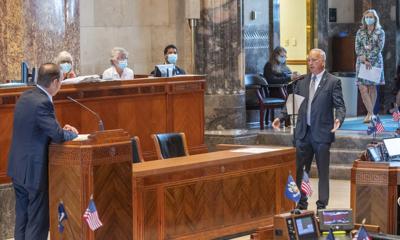
As masked Senate staff watch, Sen. Jay Morris, R-West Monroe, asks a question from the social distance microphone, right, of Sen. Patrick McMath, R-Covington, left, during debat on HB66, a tort reform bill, during legislative action Monday June 29, 2020, in Baton Rouge, La. HB66 enacts the Citizens’ Premium Reduction Act and passed 35-3. Photo credit: Bill Feig, The Advocate
Published: June 29, 2020
By: Catherine Hunt, LSU Manship School News Service
With the special session nearing the end, the Louisiana Senate passed Monday possible compromise legislation aimed at lowering auto insurance rates by limiting lawsuit options in state district courts for people injured in car wrecks.
House Bill 66, sponsored by state Rep. Richard Nelson, R-Mandeville, advanced on a vote of 35-to-3, with seven Democrats voting in support. The House last week passed Nelson’s measure, 82-9, with 21 Democrats voting for it. The legislation returns for the House to consider amendments added in the Senate.
The special session, which began minutes after the regular session adjourned June 1, must end by 6 p.m. Tuesday.
Unlike Talbot’s bill, it would reduce the default number of jurors to six from 12 to try to lessen the burden on courts and jurors. Judges expressed concerns that Talbot’s bill would overwhelm courts with jury trials and that rural areas could have trouble finding enough jurors for personal injury cases.
In another compromise, Nelson’s bill includes a mandatory rate reduction and a sunset provision that would repeal the law if rates did not decrease by at least 15% after three years. Democrats opposed Talbot’s bill because it did not mandate rate reductions, and Republicans refused to include language that would repeal the legislation if the changes did not result in lower premiums.
Unlike any other legislation on this issue, Nelson’s included comparative fault language that would prevent injured plaintiffs from recovering damages if they are found by courts or juries to have been more than half at fault for the injuries. Twenty-three states have comparative fault, said state Sen. Patrick McMath, R-Covington, who handled HB66 in the Senate Monday, and 14 states with low car insurance rates have the same provision.
Nelson’s bill also would prohibit insurance companies from setting rates based on a driver’s gender if they are over the age of 25.
Democrats sponsored bills that would have tried to lower insurance rates by prohibiting insurance companies from determining rates based on age, gender, marital status, and credit score, but faced opposition from Republicans. Edwards has said he supports these measures and that he believes “discriminatory practices” need to end in order to lower rates.
By: By Kathleen Peppo, LSU Manship School News Service
BATON ROUGE — The Senate Judiciary B Committee advanced a resolution with bipartisan support to study improved ways to fund the Louisiana Public Defender Board.
Sen. Regina Barrow, D-Baton Rouge, brought the resolution to address the chronic funding issues facing the board.
The board also is facing drastic budget cuts due to the COVID-19 crisis.
“What I’ve decided to do is put together a board that can look at best practices across the country and look for a steadier funding stream so that we are able to help those individuals who find themselves in these situations,” Barrow said.
Sen. Gary Smith, D-Norco, the chairman of the committee, voiced his support for the resolution.
He said that the vast majority of defendants that come before the criminal justice system seek assistance from public defender boards, and the defenders are “woefully, woefully underfunded.”
Barrow noted that public defenders around the state are mostly funded by money from traffic tickets, which isn’t “a good funding mechanism” because the levels fluctuate.
Rep. Ted James, D-Baton Rouge, shared his own difficult experiences with police in supporting a resolution to study policing in the state.(Sarah Gamard / LSU Manship School News Service)
Published: June 24, 2020
By: Kathleen Peppo, LSU Manship School News Service
BATON ROUGE, La. (LSU Manship School News Service) – A racially charged debate on the House floor about a resolution to establish a task force to make recommendations about policing ended with remarks from Rep. Ted James, D-Baton Rouge, about his own experiences with law enforcement.
The House approved the resolution 99-0, but only after Republicans had pushed privately before the debate to remove references to George Floyd, a black man who died when a white police officer in Minneapolis knelt on his neck for more than 8 minutes.
Rep. Blake Miguez, R-New Iberia, proposed the amendment to remove any mention of Floyd’s death. House members passed it with 67 yeas and 32 nays.
“The first piece of legislation only mentioned George Floyd,” James, who is African American, said, referring to the recent event that inspired the public outcry to which the resolution was responding. “Blake, we could have filled five pages with names.”
In an effort to ensure approval for the study that could lead to police reform, however, James reluctantly agreed to the amendment.
The resolution, written by Sen. Cleo Fields, D-Baton Rouge, had been approved by the Senate with the reference to Floyd’s death. Since the House amended it to remove that reference, the resolution will be returned to the Senate for consideration. Under the resolution, the task force would be called the Police Training, Screening, and De-escalation Task Force. It will study law enforcement training and practices and make recommendations to the Legislature.
James had agreed before the debate to delete the references to Floyd, but Rep. Tony Bacala, R-Prairieville, was not privy to the conversation. When the resolution came up for debate on the floor, Bacala, who had worked in law enforcement, said language in the resolution about blacks being three times more likely to be killed by law enforcement officers than whites addressed only one side of the issue.
By: Catherine Hunt, LSU Manship School News Service
BATON ROUGE, La. (LSU Manship School News Service) – A Senate committee on Wednesday passed a version of the state’s budget for the upcoming fiscal year and several other bills that could impact the state’s finances, including freezing pay raises for state employees. The bill, approved by the Senate Finance Committee, would use $90 million from the state’s rainy-day fund to fill budget shortfalls caused by nearly $1 billion in lost revenues estimated by state economists.
The Legislature is expected to use more than $1 billion in federal coronavirus aid to fill budget gaps. About half of those funds were used in the current fiscal year, which ends June 30, and the rest will be used in the fiscal year starting July 1.
The committee also passed three other bills Wednesday that would give about $9.6 million in tax breaks next year to hotels, retailers and restaurants trying to recover from the shutdown from the virus, which has caused more than 300,000 Louisianans to file for unemployment.
Meanwhile, the House gave final legislative approval to a tax break for the gambling industry which could cost the state $11 million next year and $83 million over five years.
Sen. Bodi White, R-Central, the chairman of the finance committee, said the various business tax breaks could total between $20 million and $25 million next year.
The Senate committee also included language in the budget bill that would temporarily freeze pay raises for state employees. That would save the state about $60 million. The money would be set aside in a separate fund, and the Legislature would consider whether to issue the pay raises later if the economy improved. If not, the money would be used to fill budget holes. Sen. Heather Cloud, R-Turkey Creek, supported the freeze, saying layoffs could be prevented “if we make wise decisions now as a Legislature.” The committee unanimously approved the plan. But Gov. John Bel Edwards, who also would have to sign off on the bill if it makes it out of the Legislature, opposed the move.
By: Kathleen Peppo, LSU Manship School News Service
BATON ROUGE — The House voted 73-18 Wednesday to approve a tax break for promotional play wagers at casinos. It would cost the state $11.2 million in lost revenues in the next fiscal year, starting July 1, and a total of $83 million over five years.
The bill is designed to help the casino industry after the major hit it took from the COVID-19 shutdown. It would allow each casino to give customers $5 million in free promotional play wagers without having the casinos having to pay state taxes on those amounts. Anything above $5 million would be taxed at the normal rate, 21.5 percent.
The Senate also had passed the bill, written by Sen. Ronnie Johns, R-Lake Charles. It now goes to Gov. John Bel Edwards.
Here is how Houma-Thibodaux representatives voted Wednesday on the casino tax break:
For: Tanner Magee and Jerome Zeringue, R-Houma and Bryan Fontenot, R-Thibodaux.
Against: Beryl Amedée, R-Gray.
As of May 17, gaming revenue was down by $122 million from a year earlier. Casinos and other forms of gaming, including the state lottery, normally bring in more revenue for the state than any other industry.
In May, the Senate Revenue and Fiscal Affairs committee rejected a resolution to suspend taxes on all promotional play wagers in the gaming industry. That would have cost the state $29 million in tax revenues next year and $217.9 million over five years.
By: Kathleen Peppo, LSU Manship School News Service
BATON ROUGE, La. (LSU Manship School News Service) – The Senate voted 36-0 Tuesday to give final passage to a bill to levy an eight percent state tax on the net revenue from fantasy sports contests. The aim is to dedicate that tax money to early childhood education, though it might only total about $375,000 a year.
A 2018 law allowed voters in each parish to decide whether or not they wanted to be able to bet on fantasy sports. Forty-seven of the 64 parishes approved it.
When fantasy sports betting was legalized, legislators said that it could not take effect unless it was taxed. The enactment of this tax is the last step in allowing citizens to bet on fantasy sports.
Sen. Troy Carter, D-New Orleans, said that many people are supportive of the bill “specifically because they understand the significance of providing resources to early childhood education.”
A revenue explanation attached to the bill gave a rough estimate of what the state will gain from the tax based on a report of New York’s income from a 15 percent tax on fantasy sports contests. The estimate suggests that Louisiana’s eight percent tax would result in about $375,000 of yearly tax receipts.
The House passed a bill by Rep. Richard Nelson, R-Mandeville, who is seeking a compromise on so-called “tort reform” legislation. (Photo: Courtesy)
Published: June 24, 2020
By: Catherine Hunt, LSU Manship School News Service
BATON ROUGE–The House passed a potential compromise bill Tuesday aimed at winning support from Gov. John Bel Edwards, who vetoed an earlier effort that sought to lower car insurance rates by limiting injury lawsuits.
The bill, by Rep. Richard Nelson, R-Mandeville, passed 82-9, with 21 Democrats voting for it. Nelson said he was trying to break the logjam on an issue that Republicans have billed as one of their biggest priorities during this legislative season.
In other action Tuesday, the House voted 82-17 to pass a bill that would prevent students and teachers who contracted infectious diseases, including COVID-19, from suing K-12 schools and colleges unless they can prove “grossly negligent or wanton or reckless misconduct.”
Earlier this month, Edwards vetoed a bill by Sen. Kirk Talbot, R-River Ridge that had addressed several components of Louisiana’s tort laws that Republicans say lead to high auto insurance rates.
Republicans appear to be short of the votes needed to override the veto, so they are trying to pass replacement legislation before the special session ends July 1.
Like Talbot’s bill, Nelson’s would extend the time that parties have to file suits and would limit the amount of recoverable medical expenses and insurance premium payments. Nelson’s bill also would lower the monetary amount an injury has to be worth to be decided by a jury rather than a judge.
But unlike Talbot’s bill, it would reduce the default number of jurors to six from 12 to try to lessen the burden on courts and jurors. Judges expressed concerns that Talbot’s bill would overwhelm courts with jury trials and that rural areas could have trouble finding enough jurors for personal injury cases.
By: Catherine Hunt, LSU Manship School News Service
BATON ROUGE–The Louisiana Senate passed 29-9 another bill aimed at lowering insurance rates by limiting damage lawsuits.
The bill by House Speaker Clay Schexnayder, R-Gonzales, attempts to change Louisiana’s legal climate that Republicans and business groups say results in Louisiana drivers paying the second highest insurance rates in the country.
A similar bill by Sen. Kirk Talbot, R-River Ridge, addressed several components of Louisiana’s tort laws that Republicans say lead to high rates, but it was vetoed by Gov. John Bel Edwards.
Schexnayder’s bill mirrors Talbot’s bill in some ways but leaves out provisions that some lawmakers say are important to lower rates.
Talbot’s bill would have decreased the monetary amount an injury has to be worth to be decided by a jury rather than a judge, called jury trial threshold; prohibited plaintiffs from suing insurance companies directly, called direct action; increased the time parties have to file lawsuits to encourage settling out of court, called prescription; and prohibited using evidence of a plaintiff receiving payment from sources besides the defendant, called collateral source.
His bill also would have allowed juries and judges to hear whether someone was wearing a seatbelt at the time of an accident.
Schexnayder’s bill, however, would only lower the jury trial threshold, prohibit juries from knowing what insurance company is involved in a suit rather than preventing companies from being sued directly and allow seat belt use into evidence.
Insurance Commissioner Jim Donelon said Talbot’s changes could have resulted in premium reductions of at least 10%. However, companies could be excused from reducing rates if they can prove that doing so would lead to insolvency. Republicans assume Schexnayder’s bill would also lower rates but could not provide an estimate.

/cloudfront-us-east-1.images.arcpublishing.com/gray/HJQWDEXNEBHOJKSIFZQFPQ36XQ.png)





 LSU Manship School Statehouse Bureau